Showing posts with label animal ag. Show all posts

Saturday, July 26, 2014

Right to Farm Part 3: Is Right to Farm a 'Blank Check?'

Continuing our conversation on Amendment 1, Missouri's Right to Farm. I have Brent Haden of Haden and Byrne, who helped draft Amendment 1.

Read Part 1: Does Amendment 1 Protect Corporations or Farmers?
Read Part 2: Is a Constitutional Amendment Necessary? 


Concern: Amendment 1 will give corporations and farmers a ‘blank check’ to do whatever they want without repercussion.

Question: How will it affect current or future regulations that protect the environment, animals, water, etc.?


Friday, July 25, 2014

How to Lose the Argument on Animal Welfare

Dave Daley, interim dean of the College of Agriculture at Chico State University in California, says that your view on animal welfare depends on what you see when you look out your window.


This is an interesting concept and one that I believe farmers and ranchers can really learn from. At the 4th International Symposium on Beef Cattle Welfare, Daley gave an outline of  "How to Lose the Argument on Animal Welfare."

Read the full story on Beef Today

Here are 12 problems that he sees with the current state of agriculture’s point of view towards animal welfare:
  1. Assuming science will give us all the answers. Science doesn't solve ethical questions. -This is important because farming and animal welfare is such an emotional topic and too often we, farmers and ranchers, look at it from a logical standpoint
  2. Using economics as justification for animal welfare practices. -Again, think emotional response, not logical. But it's OK to remind folks that farming is a business as well as a way of life.
  3. Defending all agricultural practices. Defend those practices that are defensible. You lose credibility by trying to defend all practices. -Stick to what you know and your own farming practices. "While I can't speak for all farmers or ranchers, here's what we do......" Always be honest and transparent but don't overshoot the target.
  4. We can do better at animal welfare. -While there is always room for improvement, don't rollover just to please someone else. Be proud of what you do and confident that you are doing the best that you can do on your farm.
  5. Attacking everyone who disagrees (i.e. PETA, HSUS, vegans, etc.). -This is a tough one for me. While I certainly don't oppose people's choice of eating habits, nor do I wish to change their diets, I do have issues with PETA and HSUS. Just remember that it's OK to agree to disagree and always, always, always think before you speak (or rant in my case).
  6. Not being willing to listen. -This one is HUGE! Preaching will get you nowhere fast. Listen! Don't talk at them, talk to them. Find out why he/she/they oppose what you do and create a dialogue. You don't have to change their mind, just build that bridge to better understanding. Again, it's OK to agree to disagree.
  7. Assuming the lunatic fringe is the general public. -The Fonz says, "Assumptions are the termites of relationships." True story! A lot of people just assume that you abuse animals because of how you raise them. Moral of the story: Don't add more crazy to the pot, it's filling up fast enough.
  8. Being reactive instead of proactive. -How many times have we heard this one?! This is why it is so important to tell your story.
  9. Assuming that because someone disagrees with you they are stupid, evil or both. -Didn't we just discuss this? Assumptions are the devil!
  10. Not working hard enough to build coalitions that include the public. -Connect, connect, connect!
  11. Criticizing/mocking non-conventional production systems. There is room for other methods of production, so let the market determine success or failure. -'Nough said. Just like there is more than one way to skin a cat (not that I recommend any of them), there is more than one way to sow a seed, raise a pig, etc. Live and let live. It's about bridges, not road blocks.
  12. Trying to lead a parade without seeing if anyone is following. -While this is quite humorous to witness on the streets......wait, visualize of a guy flamboyantly marching down the street with a baton and he's all by himself. Now giggle, I know I am......
The bottom line is simple, we can't butt heads with those that oppose what we do and expect to get anywhere useful. We can't fight crazy with crazy. It just doesn't work. We need to be creating conversations, real conversations were you speak, then you listen and you respond to the response. Connect, connect, connect! (name that movie)

Building bridges is what it's all about. We need to stop leaping from one extreme to another extreme, instead, we need to jaunt along the middle ground.

“I suppose it is tempting, if the only tool you have is a hammer, to treat everything as if it were a nail.” ― Abraham Maslow

Wednesday, July 23, 2014

Right to Farm Part 2: Is a Constitutional Amendment Necessary?

Again, we're hearing from Brent Haden, Haden and Byrne, who helped draft Amendment 1, Missouri Right to Farm.

This series is an effort to make this proposed amendment clearer so that you can make an educated decision before you cast your vote on August 5. 

Read Part 1: Does Amendment 1 Protect Corporations or Farmers?


Concern: Farmers already farm so a constitutional amendment is unnecessary.

Question: Why a sudden need for a constitutional amendment giving people the right to farm in Missouri? 


Monday, June 16, 2014

Waste Management on Hog Farms

The Hatton meeting regarding a proposed hog confinement operation brought up a slew of questions. In fact, a list of questions—which were somewhat answered—were handed out at the meeting.

So, with that in mind, how about a little Q&A? The following questions are from the community meeting and I will briefly answer them to the best of my knowledge and ability. 

What is the management plan for air quality and smell control?

While every farm is different, there are a few options. On our farm, we rely on trees to help control odor and fans to maintain air quality within the barns. Some farms also add air scrubbers, which basically ‘scrub’ the ammonia out of the air to reduce atmospheric ammonia. To my knowledge, these are not widely used yet because of cost but they are still in the development phase and I look forward to seeing how they develop in the future.

Another fantastic invention that is gaining popularity is digesters. Digesters convert methane gas into electricity. These are fascinating but again, there is a cost issue so not everyone uses them.

One last way we control odor is by knifing manure into the ground instead of using a traveling gun or running it through a center pivot irrigation system.


Explain how below-building waste pits work.

Basically, the pig does his business wherever and whenever he (or she) pleases. Then, their ‘business’ falls through the slat flooring and is stored in a reinforced concrete basement that is about 8 feet deep and the same length as the barn. Then, twice a year—in the fall and spring—they are pumped out and knifed into the field as a natural fertilizer.

Pit under construction.

What is the average nutrient value of the waste? Does it add organic matter to the soil or only nutrient value?

The great thing about manure is that it is basically a nutrient package deal. Just like the phone and TV companies, they bundle it. In most cases, manure provides all your phosphorus and potassium needs and the bulk of your nitrogen. Of course, only soil and nutrient testing will give a for sure answer to what is there and what isn’t but those are the three nutrients farmers always need and they are the three that are always present in manure. For farmers that don’t use manure, they have to purchase separate chemical fertilizers to cover each of these nutrient needs. Manure also adds organic matter that improves overall soil health. If you care to learn more about the nutrient and economic value here are a couple resources:

Nutrients and Value of Liquid Hog Manure

Economic Value of Liquid Hog Manure


 Will the hog urine be applied to the soils and what is the expected effect on soil quality due to urine?

I was surprised to see this question on the sheet, but it is a valid question. Yes, the poop and pee fall through the slats and into the same pit so it’s all mixed up together into one big pot of liquid gold. See previous question for soil quality concerns


How frequently will the waste pits be pumped dry?

Every fall and spring the fields get feed—by way of manure.

Do you have any questions about farming? Let me know in the comments and I’m happy to answer them.

Friday, June 13, 2014

Raising Havoc in Hatton

Recently, I had the pleasure of speaking at a community meeting in Hatton, Mo. Of course, I wasn't exactly invited to speak. I just temporarily took over the mic because that's how I roll. Aaron, my husband, begged me not to go up there. "Just leave it alone," he said. He's not much on public speaking and certainly doesn't like to stand out in a crowd. But, I just couldn't help myself. I couldn't stand there and let the crowd verbally beat down the farmer and his family without anyone to speak up for not just him but pig farmers everywhere.

This meeting was due to a proposed sow facility that an Iowa company wants to build on a Hatton farmer's land. Basically, the family farm in Hatton is teaming up with the company in Iowa to accomplish two things: 1) The Iowa company wants sows closer to Missouri finisher facilities, 2) The family farmer gets all the manure. Some may say the family farmer is getting the crappy end of the stick, but manure is invaluable to a farmer. It decreases costs, adds valuable organic nutrients to the soil and reduces the use of petroleum chemicals like anhydrous-ammonia.

The meeting was fun, for me anyway. I had forgotten just how much I love public speaking, especially when I'm talking about my family's farm. I also get a kick out of mild controversy. This meeting also reminded me that education is needed more now than ever.

Despite the efforts by farmers, ag organizations and others, consumers seem to be shifting further away from agriculture and more towards misconceptions. There's the belief that there is only one way to farm and that there must be some sort of rivalry between farmers--organic vs. modern, small vs. large, old-school vs. new technology, etc. Why?

The moral of this story is simple: If you ever get a chance to go to a community meeting regarding a local farm family, please go! In fact, any chance you get to share your farm story, do it.

My family didn't have to go to this meeting. We don't even live very close to Hatton and we have absolutely nothing to do with this business venture. We went to support a fellow farmer. We went because it was the right thing to do. I didn't have to speak. I could have just sat in the back row and kept my thoughts to myself, but I didn't. I saw an opportunity to represent farmers and I jumped on it.

My challenge to you: Make a point to share your story. Tell a neighbor, write a blog post, post something on Facebook or Twitter or go to a local meeting and start a conversation. It's easy to ignore the issue, but at what cost?

Consumers deserve to know where their food comes from and farmers—not lobbyists, extremist groups or the like—are the best ones to educate them on this matter. It's a heavy burden, but one we must carry.

Thursday, February 21, 2013

Winter Farming


Even in the winter months with the ground frozen and nothing growing farmers are still farming. There is a surprising consensuses that farmers get the winter months off but oh the contrary is true. No, we aren't in the fields but there is much, much more to farming than just cruising in the tractors. There is plenty to do on the farm to keep farmers and ranchers busy year round and then some.


Today in Missouri (and the entire mid-west) we are under a winter weather advisory. In fact, the radio just announced a state of emergency because the sky is layering the ground with an inch of snow every hour and the wind she is a blowing causing whiteout conditions.
 
Luckily, Aaron crammed the trucks in the shed and got the tractor and blade ready last night in preparation for today. There is a very good reason why farmers are obsessed with the weather and I am grateful for it, especially today.

But what about the livestock? Sure, we have tractors for pushing snow complete with cabs, heat, and air-ride seats but how are our pigs faring in this frosty weather?


Good news! Not only do we have heated cab tractors but we also have heated barns specially made for the pigs. You won't find frosty snouts and frozen hooves on our farm; instead, you'll find warm pigs with plenty of food and water. We didn't even have to break the ice for them to drink!


These huge furnaces are throughout the barn and work just like a furnace in a house. When the temperature drops the furnace kicks on until the barn reaches the toasty temperature we designate in the computer. We also have brooder heaters for the little pigs but once they are big enough to generate their own heat we take these brooders down. We also have a generator, which Aaron checked on this morning, in case the power goes out.


Despite whiteout conditions, 40-mile-per-hour winds, and freezing temperatures farmers and ranchers are out checking on their herds--both indoor and outdoor. No matter where the herd is raised--climate controlled barns, pastures, or hoop houses--farmers still have to brave the weather to get to their animals every single day. 

 What are you doing on this snowy day?

Off the subject: Is it normal to have thunder and lightening during a snow storm or am I the only one that finds that odd?

Tuesday, February 5, 2013

Farm Welcomes New Arrivals

It is always exciting when we get a new batch of pigs to raise. You never know quite what you are going to get. I imagine it is like how teachers feel at the beginning of each school year. It is fun to see the new little arrivals walk into their new home and check it out. We let them roam the alley way for a minute before we escort them to their new room in an effort to reduce stress. We don't like to rush the babies. 

This go-round we are excited to be receiving weaner pigs.

So, what's a weaner pig?

It's a pig in a bun...duh!

But seriously, a weaner pig is a piglet freshly weaned from his/her momma. They are just little guys and gals. They are also very, very cute!

 From the truck they go directly into the building, down a short hallway, and into the barn where they will grow...and grow...and grow...and grow until market weight.
 
 We just sit back and let the pigs naturally flow in and check out their new environment. We don't want to rush them or stress them. Relaxed movement, that's the key when they are still so young.

More and more file in and roam around the alley way. They sniff, snort, and get acquainted.
 Once they've had a chance to get use to the barn we move them into their very own pig pen where they get to know their roommates.
 We get to know them too.
 As you can see, they are very curious...especially when you give them something to chew on like your rubber boots, pant legs, or a nice soft leather glove...with your finger still in it. They're cute but they bite! That's okay, though, we're use to it.
Aaron's a sucker for a baby pig, especially the ones with a bit of color to them. What is funnier than seeing a manly farmer walk around holding and petting a baby pig is listening to the baby talk coming out of his mouth. But you didn't hear that from me!

This group of snouts will be with us for the next six months or so and we will raise them to a fat and sassy 280-300 pounds, approximately. It is a fun adventure and rewarding to know that these guys and gals will go on to feed thousands and thousands of people--including my family.

What would you like to know about pig farming or farmers in general?


Friday, January 25, 2013

Introducing the new Faces of Farming & Ranching


A huge CONGRATULATIONS to the new Faces of Farming & Ranching!!!! Here at Bacon Blogger HQ we are so excited for all four of these wonderful farmers and ranchers. They will do a fine job representing agriculture and everything that goes with it.

A big congrats to a friend of the blog CHRIS CHINN!!! A fellow Missouri pork producer. We are very proud of Chris and couldn't think of a better face to represent the pork industry. Way to go, Chris!

Meet the new Faces of Farming and Ranching:

Chris and her husband Kevin are 5th generation farmers - farming with his parents and brother. They raise hogs, cattle, hay and row crops.
P & S Farms is owned jointly by Bo, his wife Missy, and his parents. They grow 2,300 acres of row crops (corn, wheat and soybeans). They also have six swine finishing floors.
Katie and her husband Andy (7th generation farmer) raise corn, soybeans and seed corn.
Will and his father own/operate a dairy farm in Lamar County, Alabama. The dairy has been in continuous operation since Will’s grandfather established it on his parents' farm in the early 1950s.

Tuesday, August 7, 2012

Family Farm vs. Factory Farm

 vs.
Image from farmamerica.org
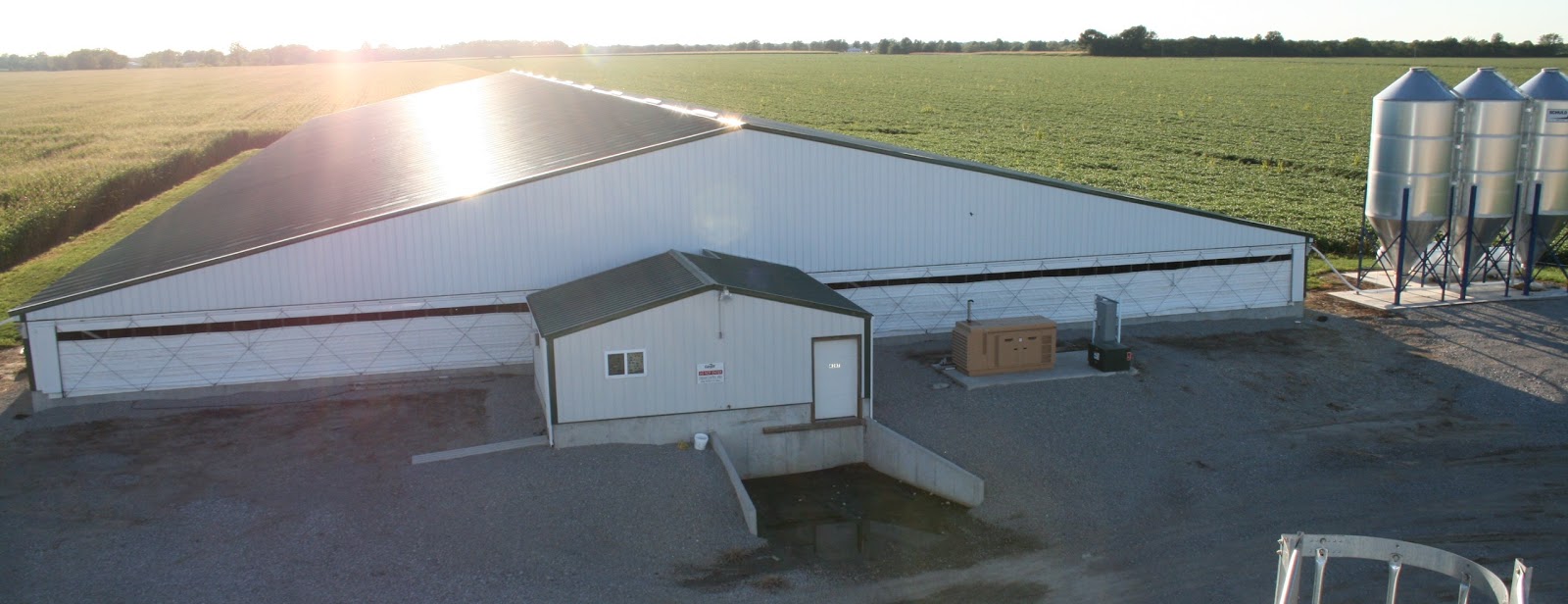
Image of hog barn from our farm
      

I’m no writer but here’s my thoughts on this whole family farming vs. factory farming thing. People have this idea that the “traditional” family farm is ma and pa with 50 pigs out back and a big red barn because that’s the way farming use to be so that’s the way it is today. But the thing that we need to tell people who have that idea that a big farm can’t be a family farm is that the family farm is still the same it has just changed its looks. We had that little ma and pa type farm but it couldn’t support one household let alone four like it does today. By going bigger and using these hog barns we are able to grow the family business and now the whole family works on the farm. We are even taking better care of those pigs and they spend their days a whole lot more comfortable than I do especially in this Missouri heat. The family farm is still the family farm no matter what size it is but it just looks different and that is not a bad thing. We’ve made lots of improvements and we continue to look for better ways to farm. But this is what we do and how we do it and we are proud to be farmers.

Wednesday, June 27, 2012

Piggy Predicament

While some may refer to our swine operation as a factory farm we do not have factory hours. While most people either enjoy a half day of work or no work at all on Saturdays, it's just another day to a farmer. What began as a day of laying irrigation pipe and doing pig chores became a frantic relay race with the clock ticking.

First, three pieces of irrigation pipe had been damaged. Of course, the guys don't find this out until they do a test run and discover some leaks. So, they have to take practically the whole thing apart, fetch new pipes, and put the whole thing back together again. This isn't a garden hose either, folks. We are talking about six-inch aluminum piping that literally runs over the hill and through the buck-brush all the way across the field. It's some serious chizz to take this thing apart and put it back together. So, what started as a be-done-by-two job ended up lasting until after four o'clock.

Here's where I come in:

There I was, minding my own business, preparing supper. Frozen burger paddies in one hand and a bag of charcoal in the other when my husband, Aaron, bursts through the door. He was in such a hurry that I don't even thing he put the truck in park before he leaped out. It was a tuck and roll situation.

Aaron:
What're you doing? What do you have going on?
Me:
It's after five, Aaron. I'm getting ready to fix supper.
Aaron:
What? Supper? No, we don't have time for that. Throw some snacks at the kids and lets go.
Me:
Huh?
Aaron:
I gotta pig emergency and I need help. Let's go. Have they ate?
Me:
The patties are still frozen in my hand. So, no. No one has ate.
Aaron:
Right. Throw some snacks at the kids and lets go.
Me:
I got that part. Calm down.

You can imagine how well the conversation went after that. So, instead of munching down some tasty grill burgars with asperagus and potatoes, the children had cold-cut sandwiches and I went without. The charcoal returned to the basement, feeling abandoned, and the frozen patties in my hand returned to their home in the freezer, feeling cold. Away we flew to the land beyond with shining white tin and lush flowing fields green (and brown, we really need some rain). Into the pigs we go.

At this point I still have no idea what the emergency is or even what I am supposed to be doing. I just slip into my fancy rubber boots and slide on my fashionable blue coveralls and hope for the best. Turns out that a feed auger in the barn needed to be repaired. So our job was to first manuver pigs around to get as many as we could out of the pin that the feed motor was in. Armed with pretty plastic sort boards we begin the hearding process. I have a huge bruise on my knee as a result of a 200 pound pig that decided he did not want to go the same direction as everyone else. Oh, well. No worse for wear. The second job requires Aaron to teader on a plastic bucket while he fights with some bolts and a heavy motor. My job during this is to make sure the remaining pigs in the pin do not chew on Aaron or his tools. Have I mentioned we are on slatted floors? That means anything you happen to drop is forever lost...like Aaron's pliers and his previous pliers and several bolts. I think there might be a cell phone down there too. Well, after everthing is replaced (luckily his brother showed up just in time to help hold the motor and what-nots) the pigs had feed again and Aaron could finally calm down.

All-in-all it was a good time...well, sort of but not really. The point is the pigs come first and we gave up our supper time to ensure the pigs got their supper time.

Farmers care about their livestock and that's the truth!

Saturday, May 26, 2012

Prosciutto Wrapped Pork Burgers

It's no secret, I love pork. Pork steaks, pork sausage, pork and beans, bacon, ham, the list goes on but nothing says summer like a nice, big, juicy, hand slapped, grill marked pork burger.
Pork burgers meet Proscuitto...


Proscuitto meet Pork burgers...

That's right, embrace the pork...

Love the pork...
Be grilled with the pork...

I'm sorry Mina, this is people food.

Phantom, you don't get any either.
Now, add a bun, some fresh tomatoes, a little lettuce, and some home grown corn...wait, let me wipe my mouth, I'm drooling.
Supper is served.
Oh, yes, I'm inspired how about you?

Wednesday, December 7, 2011

CAFO Quotes & Simple Rants

"The problem isn't a lack of food, it is poor distribution."

"We don't need CAFOs, we need better farmers."

"CAFO farmers are nothing more than pig Nazis."

"Pasture pigs taste better and are better for you."

"All CAFO farmers are the worst kind of big business farming. They put small farmers out of business and are not real farmers, just investors."

Do you feel this way? Do you agree with any of these statements? Do you find it hard to believe that anyone would think this way? Or, that any one wouldn't?

I have heard them all and then some. I’m not here to change anyone’s mind, just speak of that which I know. I know that we have an abundance of food and there is an inadequate distribution system. However, I also know that as long as we have greed, welfare dependence, obesity, foreign dictators, incompetent government officials, and ignorance we will always have a hunger issue. Yes, farmers do feed the world. Yes, we need better distribution of our food resources. However, unless you have a way of fixing all those other problems then pointing fingers at CAFO owners and distributors really starts looking asinine when you get right down to it.

Now, the claim that better farming techniques are the way to go I have to say I agree. By utilizing new technology, innovative medical know-how, and better understanding of animal husbandry….wait, we’re already doing that. Well, I’ll be dogged. The problem is misunderstanding. Most people love the idea of 1940’s and 50’s farming. It’s a great image but reality doesn’t live in great imagery. To put this in perspective, one farmer in 1940 produced enough to feed 19 people. Today, one farmer can feed 155 people. 155! That is a huge difference and we didn’t accomplish this by sitting idly by and hoping for change. We did it through technological advances and sheer determination. Let us not forget the many technological advances that were waved away by a skeptical society that now serve as a lifeline that we could not live without. Some inventions that come to mind are cars, planes, and tractors.

As far as pasture pigs tasting better and being better for you; well, the first is entirely opinion based and the latter…well, I’d like to see documentation proving that pork is healthier than pork.

As for CAFO owners being nothing more than investors and this image of big business and fat, suit clad men smoking cigars and pocketing thousands of dollars while paying minimum wage to foreign workers is the falsest claim I have ever heard. I say this with first hand experience. I am not just saying, “I heard from…” or “Well, this commercial said…” I live here and I know because we own it, live it, work it, and we are not rich. I wish the latter was otherwise but the facts are that we are owner operators. Sure, we are investors but what business owner isn’t an investor? I'd also like to know if we aren't "real" farmers than what the hell have we been doing for the past several generations?

I’d like to take this time to mention that while I feel the Nazi reference doesn’t deserve to be dignified by a comment, I have to say the ignorance shines through in any such reference. First, to compare anything to the Holocaust is disrespectful to those that suffered through it. Furthermore, to compare farming pigs—an animal—to the mass murders of thousands of innocent people seems too boorish to even put into words. Furthermore, it shows an utter lack of perspective. That is all I will say about that.

I rant for this reason:

·         98% of Americans are several generations removed from farming yet those are the ones that feel they need to tell us how to do it.

·         In an Operation Main Street 2.0 seminar in Kansas State University, out of 100-plus veterinary students only two or three had any experience in swine production.

·         HSUS claims to be all about animal welfare however they only give $0.19 cents of that famous $19 they ask for in their ads--less than 1% of donated funds. While farmers spend tens of thousands of dollars on their animals to make sure they have a safe environment, food, shelter, water, and all their veterinary needs are met. 
·        We have the We Care program, Operation Main Street, PQA Plus, and many other programs, seminars, and mandatory training to ensure proper animal care and handling. How are we not advocates of animal welfare?


·         Finally, how else do we do it? If you know a better, more economical, more efficient means of raising these animals and feeding the world then why don’t you share it with the thousands of vets, engineers, scientists, nutritionists, farmers, etc. that are waiting to hear from you.
  I suppose the ultimate point is that of knowledge. Before you take the word of some commercial you saw or some conversation you overheard why don’t you get the facts for yourself. Ask a farmer. Talk to a vet. Question a butcher. Take a tour of a farm. Just don’t judge before you have all the facts and never jump to conclusions.