Showing posts with label factory farms. Show all posts

Thursday, March 28, 2013

Sustainable Ag and Food Myths Busted

Sustainability

This is a powerful word that is creating buzz all across the ag world and among consumers, corporations, farmers, families, everyone, everywhere. I watched a video--just today, in fact--that claims to have all the answers but do they really?

Food MythBusters, which is a "campaign to provide videos and resources debunking the yarns Big Ag players spin about our food system," created a video that, in my book, invokes more questions than answers. The video states that the story of "Big Ag" (I'd love a definition on what "Big Ag" really is because I think we fall into that category but we aren't that big in comparison, we are also family owned but we contract too--define please) is "full of holes" but I found a few "holes" of my own. 

So, lets break it down piece by piece:
  1. "[Farmers] Stop practices that keep soil healthy" -- If we don't keep the soil healthy then we would not be able to continue to produce year after year. This statement implies that farmers are irresponsible and uncaring, which is illogical. Comparable to a mechanic that refuses to service vehicles. He won't be in business for very long! Crop rotation is mentioned in the video and is a great way to keep soil healthy. Every farmer in this area, including us, rotates our crops. Usually between corn, soybeans, wheat, and sometimes a cover crop like cereal rice or rye. So, are we really stopping the practices that keep soil healthy or are consumers just confused about farming because they've been removed from it for so long?
  2. "Livestock, that use to be raised on the farm, get crammed into polluting factories"-- Our livestock are still raised on the farm. We use barns and modern technology to raise them but they are
    still on the farm. We live down the road from one of our barns and my sis-in-law and parents-in-law live next door to our other barns. How is this not on the farm? Furthermore, if we were polluting then we would only hurt ourselves. Not only would we be violating our government issued permits (hefty fees for doing so) but it is our water and our land that would be polluted. Would you pollute your own water? Additionally, if we were a factory then we would have better pay and more benefits. I've seen what the factory workers in town make, heck of a lot more than my husband and they don't even do a fraction of the hard labor. Maybe we should all just work in a factory...Nah!
  3. "These farmers now buy expensive inputs" -- Hate to state the obvious but inputs have always been expensive and farmers have purchased them for decades. Inputs, expensive or otherwise, are nothing new. However, the good news is that while farmers still use chemical inputs we use a lot less. Like, 223 million pounds less! Wait! It gets better. Despite using hundreds of millions of pounds less in chemicals we are producing more in yields. Maybe Obama and Congress should take a few hints from farmers on how to use less while getting more to get our economy back on track. Farmer for President! So, are we buying more inputs?
  4. "Got to use more drugs [on livestock]" -- Again, antibiotics are not new to the world of farming and the use of antibiotics is not even related to the size of a farm. Farmers that have 10 animals or 10,000 animals all use antibiotics to keep their animals healthy. Unless they are certified organic, then the animals just get chicken soup and wait to die. I'm joking, dark but still a joke! I know some organic farmers and they are wonderful people. Seriously, another interesting fact is that in an IFT report a panel of experts estimate that 96% of antibiotic resistance is actually from human use, not animal use. So, is the "more drugs" an issue of one singular group or do we need to look at the bigger picture and discuss the use of drugs across the board, primarily with human use?
  5. "Got to use more chemical fertilizer [on crops]" -- I will again state what I said in #3: Like,223million pounds less! Not only are we using less chemicals of every kind but our farm, our neighbors (plural, all of them with pigs), along with friends and family that all raise pigs in barns use less chemicals than ever before because we have the power of poop. I know for a fact that hog farmers use all that poo in their lagoons and, more commonly, their deep pits to fertilize their crops the way grandpappy use to. Pardon me, do you have any Grey Poop-on? Why, yes. Yes we do.
  6. "Corporate ag is good for some folks...not the typical farm family" -- Who is the "typical" farm family? We could be considered under the label "corporate ag"because we contract our pigs through a larger company, as many do. Our family's farm began with less than 100 acres and a husband and wife with three kids attempting to fulfill their dream. Since then, it has grown over the last couple decades to several hundred acres, several thousand hogs, and employs all three children plus spouses and then some. The same is true for several other pig farmers we know. So, how are we not the "typical" farm family? And, if we aren't then who the heck is?
 The bottom line is that I want you to watch the video. I want you to make your own judgment call. But more than anything, I want everyone to understand that farming is just like skinning cats--not the gross, bloody, scratches up and down your arms kind of way, more like there's more than one way to do it kind of way. It is an idiom. I'm not really skinning cats. You people are gross.

Watch the video and let me know what you think. Unlike Food MythBusters, comments are always open and welcome.
 

Tuesday, March 12, 2013

Snide-ness and Factory Farming: Now open for dialogue

Today I read a comment on one of the BaconCam's YouTube videos that sparked my interest. So, thank you Spikutus for your comment.

Factory Farming Exposed:  Truth about animal handling


Their comment was:

What a snide attitude the narrator has! As if because those bad things don't happen on HER farm, they don't happen anywhere. Who is the one who has to wake up?

I realize that this doesn't seem like a friendly comment that I'd want to point out but there is a great point to be made here, plus a good conversation.

When I narrated this video I was apprehensive about actually posting it. The narration is, as Spikutus points out, snide and much more abrasive than my usual demeanor. I was worried that it would be taken the wrong way or that people would get upset by it or that I would look like a jerk because of it. However, I put on my big-girl panties and made a conscious decision to let my abrasive side show despite the discomfort it gives me (abrasive sides tend to be scratchy, itchy, and they chafe terribly).

The fact is, I had a point to make.

The snide-ness, as I like to call it, was in rebut to all those so-called "abuse" videos with the same exact attitude or snide-ness. In the videos that I have seen the message is clear: This abuse happens here so it must happen on every farm! This is the message I wish to refute most adamantly. Therefore, I took the same attitude, which is so prevalent in the "abuse" videos and spun it the other way.

That was my  point and obviously it hit target.

I know animal abuse exists. I am not refuting that. It saddens me, upsets me, and down right pisses me off that people abuse their animals. However, the same emotional outcome applies to people that want to lump every farmer in one big abusive basket because we choose barns for our farms. That may be my new bumper sticker, by the way.

On a side note, it sickens me to watch those abuse videos that actually show abuse especially when the person filming does absolutely nothing to stop it. Does that not make them every bit as guilty? Well, in my book it makes them worse. It makes them a hypocrite of the worst kind. But I digress.

I'm glad this person commented on the video because the point of everything--the blog, the BaconCam, the social media outlets--is to open the lines of communication. To start dialogues that actually lead somewhere besides an argument. If we can understand both sides of the fence we can make changes, we can better our farming practices, or we can just agree to disagree--at least we are talking and not fighting.

So, as the title states, we are officially Open For Dialogue!

Thursday, August 23, 2012

Still Preparing for Portland and IFBC 2012


The clock is ticking...

Who knew preparing a speech/presentation, practicing my answers to panel questions, stressing over finals week (yes, I'm still in school...arrrg), going to work all day every stinking day after day after day...I'm digressing...and being a mom (not to mention a farmer's wife) could be so exhausting. Sometimes I wonder if I take on too much.

Might be a tiny, tiny bit stressed...
Nah! I can handle it. I may have a mental breakdown every now and again and start randomly screaming out profanities but my family is use to it by now. Right? I can do this. Right? Right?!

Okay, I'll admit it, I'm a tiny bit stressed but despite my temporary insanity I am super excited about IFBC 2012 in Portland. Not only do I get to tell my story but I also get to have what I am sure will be a fantastic breakfast sponsored by the National Pork Board.

Do you think they'll serve bacon?

I am amazed and proud that farmers and farming organizations are finally breaking their silence to tell their stories straight from the hog's mouth. This is a unique opportunity to speak with a group of people that under any other circumstances wouldn't know I even exist nor I them. Along with Heather from 3 Kids and Lots of Pigs, we will get a chance to tell our stories and answer questions and I am sure they will have plenty. It's nerve racking but exciting.

These conversations are so vital to the future of farming. Agriculture touches each and every one of our lives no matter your geographical location or your food beliefs. We don't all have to agree--heavens to Betsy, no--but we do need to keep an open mind and an open heart to move the conversation forward.

Missouri Farm--Corn Field
Farming has come such a long way but it still has a very long way to go. Improvements keep coming but we need to keep everyone involved to make sure we never stop striving to make farming better and better.

I am looking forward to the future of farming.

How about you?

Sunday, August 12, 2012

Sustainable Farming...We do that!

I got this email with a website link on it and a simple message:

Thought you might find this interesting.
Les
 Well, I was interested...very interested. So interested, in fact, that I think it needs to be shared with anyone and everyone that cares about both pig farming and a healthy environment. The PorkCheckoff funded some research to evaluate whether or not pig farming has improved over the years and to see what areas needed further improvment.
The research shows that pork production is more sustainable now than ever before. The first sentence of this article was fantastic and it sums up what we've been trying to tell everyone from the beginning:
"A new study finds that while pig farms of the 1950s may be remembered as idyllic, they were not as sustainable as those of today."
The study found that today's hog farms have decreased their carbon footprint by 35 percent since 1959. Additionally, we (hog farmers) use 41 percent less water and 78 percent less land per pound of pork produced. That is a huge accomplishment in farming! We are able to produce more while using less and protecting our envirnment.
We are still looking for ways to improve farming across the board but I think it is also important to celebrate our current accomplishments. This study shows just one of those accomplishments.
What do you think? 

Tuesday, August 7, 2012

Family Farm vs. Factory Farm

 vs.
Image from farmamerica.org
Image of hog barn from our farm
      

I’m no writer but here’s my thoughts on this whole family farming vs. factory farming thing. People have this idea that the “traditional” family farm is ma and pa with 50 pigs out back and a big red barn because that’s the way farming use to be so that’s the way it is today. But the thing that we need to tell people who have that idea that a big farm can’t be a family farm is that the family farm is still the same it has just changed its looks. We had that little ma and pa type farm but it couldn’t support one household let alone four like it does today. By going bigger and using these hog barns we are able to grow the family business and now the whole family works on the farm. We are even taking better care of those pigs and they spend their days a whole lot more comfortable than I do especially in this Missouri heat. The family farm is still the family farm no matter what size it is but it just looks different and that is not a bad thing. We’ve made lots of improvements and we continue to look for better ways to farm. But this is what we do and how we do it and we are proud to be farmers.

Wednesday, August 1, 2012

Preparting for Portland & IFBC 2012


As an active agvocate, I am always happy to share my story. So, you can imagine my excitement when Teresa from the National Pork Board contacted me about a unique opportunity. The National Pork Board is sponsoring a breakfast at this year’s International Food Bloggers Conference, which will give food bloggers a chance to talk directly to hog farmers and learn more about modern pork production. Well, since we are simply Hog Wild about farming I was all too happy to say YES to this great opportunity to meet new people and spread the word of AG. The IFBC 2012 is being held in Portland, OR this year so that makes it even more exciting for two reasons: 1) I have never been to Oregon; 2) This is a rare chance to connect with people (particularly foodies) that I normally would never encounter. I believe between the Pork Board’s efforts and that of the U.S. Farmers and Ranchers Alliance we are definitely on the right track to an open dialogue between farmers and consumers. There is a communication gap between the people that raise food and the people who only see the end result. This gap must be closed in order to not only improve farming but improve the way people think about farming. Never have people felt so removed from the farm and this is why, I think, there is such uproar over farming practices. While farming has improved over the decades we are still learning and it still has a long way to go; however, farming will never reach its full potential if we do not connect with the people that depend on us. Farmers know the land, they know their animals, but they don’t know everything and it is easy to become jaded and lose sight of the bigger picture. This is why we need to open the lines of communication on both sides of the gap. We may not agree on everything put if we at least have an open conversation about it we stand to learn more than we ever thought possible. Each side has legitimate concerns and each side thinks they know better but how can we improve if we never look at the other side? There is more than one way to farm and that is what makes farming fabulous—it’s diversity.

The main topic of this breakfast panel is the We Care Initiative and how we use it on our farm. This may sound like a slogan to some but for pork producers it actually means something. Here is a video that gives a sample of what the We Care program means:


I am looking forward to speaking with all the chefs, food bloggers, agents and editors, cookbook writers, and otherwise food curious folks in Portland. I am hoping for an enlightening and enjoyable conversation about food, farming, and the yumminess of pork. Hope to see you in Portland.

Are you going to this year’s IFBC? I’d love to hear from you!

Sunday, July 29, 2012

Factory Farms: An Issue of Scale

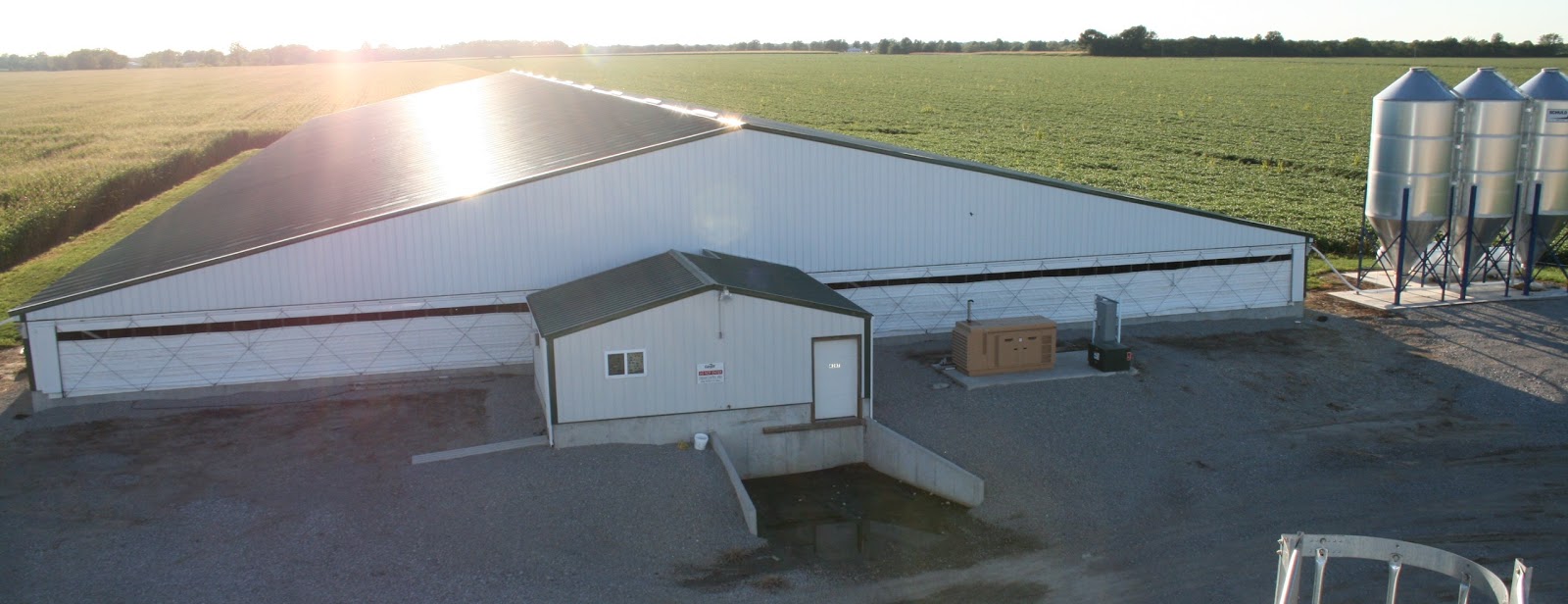
Factory farm or family farm?
As a concerned mother, wife, and fellow consumer I can understand how the idea of a “factory farm” can scare, anger, or even confuse the general public. However, as a farmer’s wife and pork producer I must ask what is a “factory farm” anyway?

I have found through reading blog posts, tweets, and FB comments that the biggest defining factor for “factory farms” is an issue of scale. The bigger the farm the more likely it will be categorized as a “factor farm.” Technology also plays a role in people’s perception. The more we utilize technology the more we are all lumped into a corporate farming pile.

But does a larger scale of farming make you a factory/corporate farmer or a successful/sustainable farmer?

We raise 26,000 pigs over the course of a year plus several hundred acres of corn and soybeans. We utilize modern farming techniques to make us more efficient, safe, and environmentally friendly. Because we are larger in scale and have modern techniques does that make us factory farmers or successful farmers?

Fertilizer--knifing hog manure
We also participate in contract farming. We contract pig space and have manure spreading agreements with local farmers. This means that we “rent” pig space in our barn and—as a family—raise company owned pigs in our family owned and operated barns. The manure spreading agreements help fellow farmers reduce fertilizer costs while still putting needed nutrients into the ground in the form of a natural fertilizer. By farming in this way our farm has grown large enough to support four separate households—all of which are family members. So, are we factory farmers or family farmers?

I suppose the biggest issue here isn’t scale, technology, or even technique; instead it seems to be a matter of perception. The original 50 acre farm with a few dirt hogs wasn’t enough to maintain a growing family and by utilizing modern farming practices we were able to grow in size and support four separate family households.

To me this says successful farming because it is done responsibly; however, many don’t agree with that. It would seem there is a double standard in farming. If any other business grows in size over the course of years and is able to employ more people it is seen as a successful business and the business owner is considered to be living the “American dream.” However, if we place a farmer in this same scenario the farmer is considered a “corporate sell-out” or “factory farmer” instead of being seen as successful. Why is this? Why can’t farms be large in scale but still maintain family values and ownership?

So I ask again: What is a “factory farm” anyway?

Wednesday, June 27, 2012

Piggy Predicament

While some may refer to our swine operation as a factory farm we do not have factory hours. While most people either enjoy a half day of work or no work at all on Saturdays, it's just another day to a farmer. What began as a day of laying irrigation pipe and doing pig chores became a frantic relay race with the clock ticking.

First, three pieces of irrigation pipe had been damaged. Of course, the guys don't find this out until they do a test run and discover some leaks. So, they have to take practically the whole thing apart, fetch new pipes, and put the whole thing back together again. This isn't a garden hose either, folks. We are talking about six-inch aluminum piping that literally runs over the hill and through the buck-brush all the way across the field. It's some serious chizz to take this thing apart and put it back together. So, what started as a be-done-by-two job ended up lasting until after four o'clock.

Here's where I come in:

There I was, minding my own business, preparing supper. Frozen burger paddies in one hand and a bag of charcoal in the other when my husband, Aaron, bursts through the door. He was in such a hurry that I don't even thing he put the truck in park before he leaped out. It was a tuck and roll situation.

Aaron:
What're you doing? What do you have going on?
Me:
It's after five, Aaron. I'm getting ready to fix supper.
Aaron:
What? Supper? No, we don't have time for that. Throw some snacks at the kids and lets go.
Me:
Huh?
Aaron:
I gotta pig emergency and I need help. Let's go. Have they ate?
Me:
The patties are still frozen in my hand. So, no. No one has ate.
Aaron:
Right. Throw some snacks at the kids and lets go.
Me:
I got that part. Calm down.

You can imagine how well the conversation went after that. So, instead of munching down some tasty grill burgars with asperagus and potatoes, the children had cold-cut sandwiches and I went without. The charcoal returned to the basement, feeling abandoned, and the frozen patties in my hand returned to their home in the freezer, feeling cold. Away we flew to the land beyond with shining white tin and lush flowing fields green (and brown, we really need some rain). Into the pigs we go.

At this point I still have no idea what the emergency is or even what I am supposed to be doing. I just slip into my fancy rubber boots and slide on my fashionable blue coveralls and hope for the best. Turns out that a feed auger in the barn needed to be repaired. So our job was to first manuver pigs around to get as many as we could out of the pin that the feed motor was in. Armed with pretty plastic sort boards we begin the hearding process. I have a huge bruise on my knee as a result of a 200 pound pig that decided he did not want to go the same direction as everyone else. Oh, well. No worse for wear. The second job requires Aaron to teader on a plastic bucket while he fights with some bolts and a heavy motor. My job during this is to make sure the remaining pigs in the pin do not chew on Aaron or his tools. Have I mentioned we are on slatted floors? That means anything you happen to drop is forever lost...like Aaron's pliers and his previous pliers and several bolts. I think there might be a cell phone down there too. Well, after everthing is replaced (luckily his brother showed up just in time to help hold the motor and what-nots) the pigs had feed again and Aaron could finally calm down.

All-in-all it was a good time...well, sort of but not really. The point is the pigs come first and we gave up our supper time to ensure the pigs got their supper time.

Farmers care about their livestock and that's the truth!

Friday, June 22, 2012

The Cent of Swine

This is a post that I feel needs revisiting because it is an important factor in the farming industry. Manure management is also an environmental issue and John Q Public needs to know more about the renewable resource (and money saving resource) that we are producing. Enjoy...

A lot of folks whine, cry, and complain about the smell of a hog house but let me tell you...that, my friends, is money you are smelling. Don't get me wrong, we aren't a bunch of suits snapping our greedy claws at every dollar we see; we are family farmers. That means family owned and operated but farming is first and foremost a business...no matter what kind of farming you do. Furthermore, which is better, natural or chemical? Well, when it comes to fertilizer, I'll take natural over chemical any day of the week.

I ran across an interesting blog post The smell of money from a blog I follow, Brumm Speaks Out. In his post, Mike explains the financial benefits of utilizing swine waste as a natural fertilizer. He also describes the nutrients found in hog waste. Of course, here at Bacon Blogger HQ we have always appreciated our manure but here is a mathematical breakdown excerpted from Mike Brumm's post:

The average composition of the manure in pounds per 1000 gal of manure was 60 pounds of nitrogen, 30 pounds of phosphate (P2O5), 35 pounds of potash (K2O), 7 pounds of sulfur and 1 pound of zinc.

At the same time, I’ve seen prices quoted for commercial fertilizer in the range of $800/ton for anhydrous ammonia (82% N), $600/ton for phosphate and $800/ton for potash. Applying these values to the above manure analysis, the manure is worth $42.80/1000 gallons as it is removed from the pit.

For a wean to finish barn, you get about 340 gallons of manure per pig space per year or a net value at time of land application of $9.25 per pig space. For a 1250 head facility, this is $11,560.

When applied at 180 pounds of nitrogen per acre (3,000 gallons per acre), this becomes 8.2 pig spaces per acre from a grow-finish barn with a total land need of 150 acres.

Now, to put this into perspective, I'll give you the scoop on pig poop. To use a chemical fertilizer it will cost a farmer around $200 to $300 per acre; whereas for manure, we only pay what it cost to run the machinery--which doesn't even come close to $300 per acre. We also apply manure for other farmers and charge a fraction of what it cost to use chemical fertilizers. Furthermore, according to recent Canadian research manure actually helps rebuild topsoil. I think we can safely say that manure isn't waste, it is one of the most valuable byproducts from pigs. And, with proper waste management it can be an invaluable renewable resource for farmers.

Here is another scoop on pig poop:

Tuesday, June 12, 2012

Fair Oaks Pig Adventure Center

Have you heard about the Fair Oaks Pig Adventure Center? It is fantastic! It is one of the best ideas and I cannot wait until it is up and running. The Fair Oaks Project is a proposed working sow farm with enclosed walk ways, an education center with exhibits and other educational tools, and is a way for the general public to see first-hand how a sow operation works. How proactive is that!

 The new Pig Adventure Center will be located in Indiana about a mile away from the main Fair Oaks campus. Currently, Fair Oaks has a Dairy Education Center that allows the public to view the daily activities involved with dairy farming.


 The new pig site will allow the public to view a 2,400-head sow farm from a viewing stations and walk ways. This is such a great idea because the average American is at least three generations removed from the farm. Not only does it allow a first-hand encounter with pork production but it also helps the general public to understand modern farming techniques and practices.


I am very excited about this project and hope to be present on opening day.

Check out this months Pork Checkoff Report to learn more about the Fair Oaks Pig Adventure Center.

Thursday, June 7, 2012

Double Standards in Animal Care

I have noticed some interesting blog posts, comments, and sentiments about the proper way to care for animals. For example, I recently read a blog post that described the best way to care for a dog is to keep them indoors and insinuated that outdoor dogs can become vicious.
English Shepherd Image by Jo Windmann

Yes, outdoor dogs can become vicious. Just look at this one...she's a real killer. Don't let the lazy attitude fool you, she's primed for the attack.

Image courtesy of Google Images
 This is a kennel I found because according to popular believe dogs should not be allowed to roam free. If they roam free then they could get sick, hurt, attacked, lost, or killed.


English Shepherd Dog by Jo Windmann
Image courtesy Google Images


Yes, let's kennel them or keep them locked in the living room watching TV with us. I'm sure dogs prefer prime time over a romp in the grass anyway. Just look at these two examples above. It is obvious which dog is happier and healthier. Don't you agree?


Image courtesy Google Images
Disturbing image that I feel guilty for actually using
I am sorry Mina
This one I love. It is healthier to have a dog in the house and to train it to poop and pee where it lives. After all, you wouldn't want to find a steamy cookie in the yard because it is better to discover that kind of filth in your own home...really?
Wait! You want my dog to do what in my house!? I don't think so.

To summarize: If your dog does not live indoors (and apparently to his business indoors) then you are a bad pet owner.

Now, on to farm animals:
CAFO hog picture by Jo Windmann
Farm animals should be kept outdoors and free to roam on the wide open acres. They should not do their business indoors because that is disgusting and inhumane to make them live in their own filth. Despite the fact that their poo lives in a pit several feet below them not in the pen with them.

To summarize: As farmers, we should not confine our livestock in any way despite the fact that they could get sick, hurt, attacked, lost, or killed by predators.

To further summarize:

There is a serious double standard in animal care. Dogs are seen as people not animals, pigs are seen as animals not livestock, and one should be confined indoors for their own protection and well-being, while the other is considered abused for being kept indoors for their own protection and well-being.

Is anyone else confused?

I have nothing against indoor animals. I have nothing against outdoor animals. I think animals should be cared for according to their own individual needs and the individual preferences of their owners. Period. As for us, we like our piggies inside and our puppies outside. Do either look abused to you?


Precious picture of father and son petting a pig
My baby and my puppy playing in the tall grass


Wednesday, December 7, 2011

CAFO Quotes & Simple Rants

"The problem isn't a lack of food, it is poor distribution."

"We don't need CAFOs, we need better farmers."

"CAFO farmers are nothing more than pig Nazis."

"Pasture pigs taste better and are better for you."

"All CAFO farmers are the worst kind of big business farming. They put small farmers out of business and are not real farmers, just investors."

Do you feel this way? Do you agree with any of these statements? Do you find it hard to believe that anyone would think this way? Or, that any one wouldn't?

I have heard them all and then some. I’m not here to change anyone’s mind, just speak of that which I know. I know that we have an abundance of food and there is an inadequate distribution system. However, I also know that as long as we have greed, welfare dependence, obesity, foreign dictators, incompetent government officials, and ignorance we will always have a hunger issue. Yes, farmers do feed the world. Yes, we need better distribution of our food resources. However, unless you have a way of fixing all those other problems then pointing fingers at CAFO owners and distributors really starts looking asinine when you get right down to it.

Now, the claim that better farming techniques are the way to go I have to say I agree. By utilizing new technology, innovative medical know-how, and better understanding of animal husbandry….wait, we’re already doing that. Well, I’ll be dogged. The problem is misunderstanding. Most people love the idea of 1940’s and 50’s farming. It’s a great image but reality doesn’t live in great imagery. To put this in perspective, one farmer in 1940 produced enough to feed 19 people. Today, one farmer can feed 155 people. 155! That is a huge difference and we didn’t accomplish this by sitting idly by and hoping for change. We did it through technological advances and sheer determination. Let us not forget the many technological advances that were waved away by a skeptical society that now serve as a lifeline that we could not live without. Some inventions that come to mind are cars, planes, and tractors.

As far as pasture pigs tasting better and being better for you; well, the first is entirely opinion based and the latter…well, I’d like to see documentation proving that pork is healthier than pork.

As for CAFO owners being nothing more than investors and this image of big business and fat, suit clad men smoking cigars and pocketing thousands of dollars while paying minimum wage to foreign workers is the falsest claim I have ever heard. I say this with first hand experience. I am not just saying, “I heard from…” or “Well, this commercial said…” I live here and I know because we own it, live it, work it, and we are not rich. I wish the latter was otherwise but the facts are that we are owner operators. Sure, we are investors but what business owner isn’t an investor? I'd also like to know if we aren't "real" farmers than what the hell have we been doing for the past several generations?

I’d like to take this time to mention that while I feel the Nazi reference doesn’t deserve to be dignified by a comment, I have to say the ignorance shines through in any such reference. First, to compare anything to the Holocaust is disrespectful to those that suffered through it. Furthermore, to compare farming pigs—an animal—to the mass murders of thousands of innocent people seems too boorish to even put into words. Furthermore, it shows an utter lack of perspective. That is all I will say about that.

I rant for this reason:

·         98% of Americans are several generations removed from farming yet those are the ones that feel they need to tell us how to do it.

·         In an Operation Main Street 2.0 seminar in Kansas State University, out of 100-plus veterinary students only two or three had any experience in swine production.

·         HSUS claims to be all about animal welfare however they only give $0.19 cents of that famous $19 they ask for in their ads--less than 1% of donated funds. While farmers spend tens of thousands of dollars on their animals to make sure they have a safe environment, food, shelter, water, and all their veterinary needs are met. 
·        We have the We Care program, Operation Main Street, PQA Plus, and many other programs, seminars, and mandatory training to ensure proper animal care and handling. How are we not advocates of animal welfare?


·         Finally, how else do we do it? If you know a better, more economical, more efficient means of raising these animals and feeding the world then why don’t you share it with the thousands of vets, engineers, scientists, nutritionists, farmers, etc. that are waiting to hear from you.

  I suppose the ultimate point is that of knowledge. Before you take the word of some commercial you saw or some conversation you overheard why don’t you get the facts for yourself. Ask a farmer. Talk to a vet. Question a butcher. Take a tour of a farm. Just don’t judge before you have all the facts and never jump to conclusions.

Thursday, August 25, 2011

Factory Farming Exsposed

Learn the truth about animal handling practices in factory farms!
You'll be shocked by what you see!!


Sunday, July 3, 2011

Antibiotics & Factory Farming--A bitter rant

Image from http://www.antibioticsandalcohol.org/

Antibiotics are a funny thing and recently I had an opportunity to get up-close and personal with them. You see, in the last few weeks my household has suffered from strep throat, a sinus infection, flu-like symptoms, and the good ol' common cold--this is summer right? Wait, let me check.....yep, 90 degrees and a thunderstorm brewing....it's summer......but I digress.

While each of us suffered in our own special way we met with our local family physician on more than one occasion. The funny part is how quick and easy antibiotics are prescribed and no one so much as bats an eye. We walked in, the doc took one look at my daughter's throat (the instigator of all this or was it my husband? Who cares! I feel like crap.) and said, "Oh yeah, I'll get you fixed up with some antibiotics for that throat. Be back in just a few minutes." That was that. A nurse swabbed my daughter's throat for verification and Presto! antibiotics in hand and we are out the door. Same scenario for each of us. We walk in feeling like we came out the back side of a bean burrito eating fool and we walk out with a hand full of antibiotics and no one seems to care.

Moral of the story is: 'Tis better to treat our symptoms to minimize suffering but let the sick little piggies die a miserable unnecessary death.

Does anyone else have a problem with this moral? Because I feel like I'm all alone in questioning this one.


Image from donlonpharmacy.com
 Why is it okay to treat ourselves with antibiotics when we are sick and suffering but it is a fowl misguided act to provide proper medical care to our livestock? I have seen so many fingers pointed at the pork industry because we use antibiotics on the pigs. Here is the kicker folks. We also raise ABF pigs--that is Antibiotic-Free pigs for all you laymen out there--and it is a sad, sad thing to see.

I remember this one group of pigs that came in and they were doing well until a few of them got sick. Nothing we could do so we segregated the sick ones to the sick pin and hoped for the best. But they are like kids in a daycare; when one gets sick, they all get sick. It was such a simple sickness, too. I believe they had nothing more than a cough but it has been some time and I have the memory of an Alzheimer's patient. It could have been easily cured, they could have been better in a matter of a few days. Instead, because they were ABF pigs our hands were tied.

We had to watch them slowly die of a curable illness. Let me tell you, nothing is more irritating, nauseating, and down right upsetting than watching a creature slowly and miserably die when you hold the cure in your hand but some group of people which have never farmed nor seen beyond city limits says it is more humane to refuse them antibiotics. Yeah, right!

Image from blogs.seattleweekly.com
To all the animal rights groups and their supporters my point is this, next time you are feeling sick and miserable, remember, it is more humane to go without antibiotics. Next time you are feeling like a puddle of sweaty flesh and want to slip into the A/C, remember, it is more humane to suffer in the heat. Next time you are feeling like Jack Frost literally nipped your nose blum off your face, remember, it is more humane to freeze to death than to have heating. Finally, remember, it is more humane to go without proper vaccinations so when your child dies of measles, you did the right thing by not treating them. After all, we must treat people and animals equally so it was better your little one died because that is what happens to our pigs when we are forced to raise them antibiotic-free.

**Insert bitter sarcasm here**

Thanks Mercy For Animals. Thanks Humane Society of the United States. Thanks People for the Ethical Treatment of Animals. Thanks all you misguided fools that support these groups and the like. You have really helped bring awareness to the abuse of livestock. We farmers and ranchers should know better than to give our livestock heating in the winter, cool air in the summer, and proper medical treatment. What were we thinking!? Thank you. You have all helped a heap. When animals have friends like you, who needs natural predators in the wild?

I've had a rough few weeks....does it show?

Tuesday, May 31, 2011

Lazy Days on the Farm

While my husband slaves away on the farm the kiddos and I have the pleasure of enjoying the nice days out in the open air. The tire swing is a favorite but just swinging on it isn't good enough for these two. 

They have to jump........

and fall.


Still too lame......

They have to find something higher to jump off. 
 Mina just watches the insanity and possible injury unfolding before her eyes.

After a day of jumping, falling, and only minor injuries curable via a bandage, another day begins.

Waylon discovered a new pastime.
If he shoots it, she will fetch it.

Even that gets old and the kids poop out....

And whine about being bored.
 There's no pleasing these two.


Then there is this.........


I know it's wrong and I apologize for my behavior. Forgive my weirdness.