Showing posts with label hog farm. Show all posts

Sunday, January 23, 2011

Yummy Hunk-O-Loin

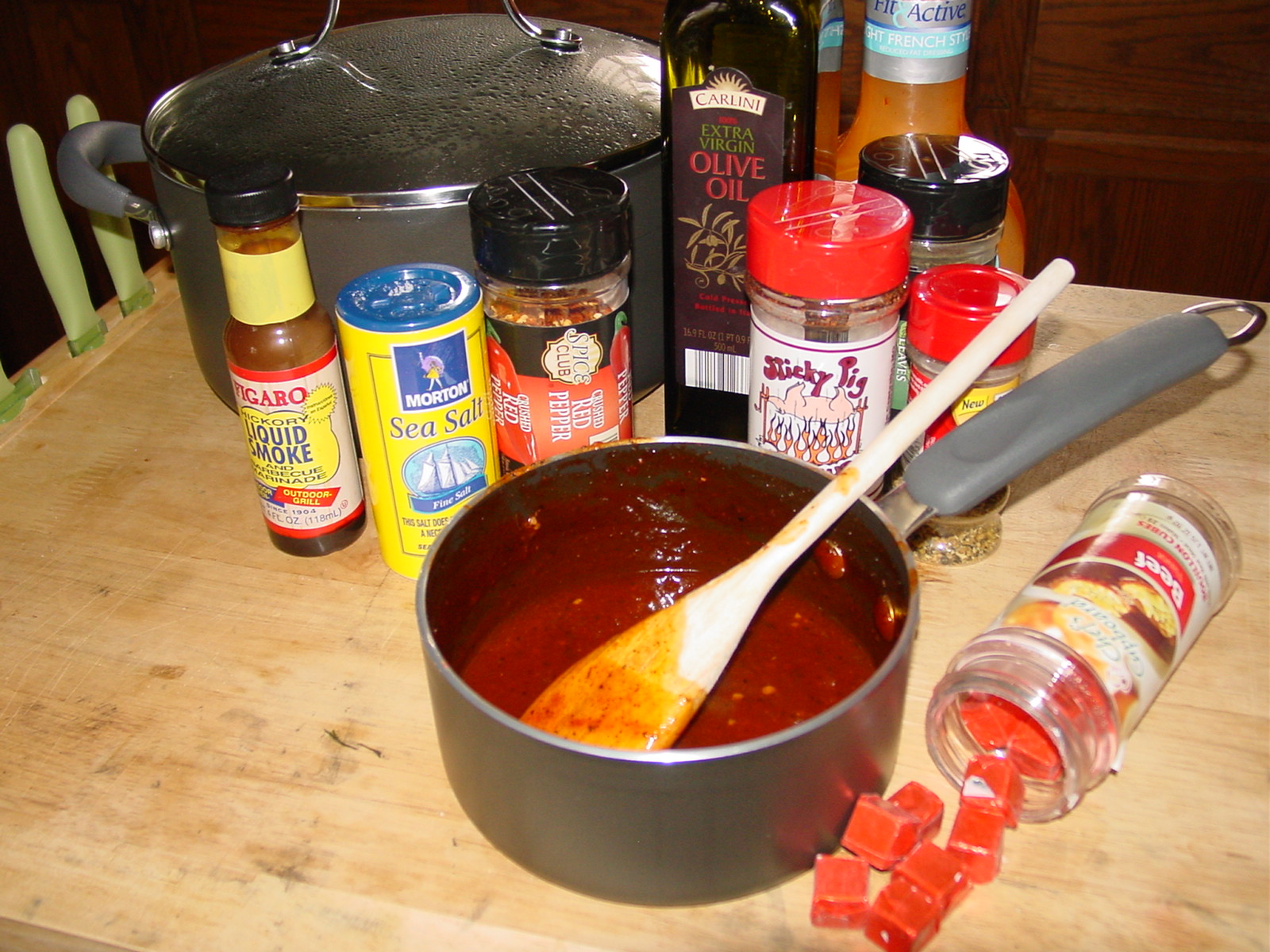
What do you get when a bored pork lover stands in her kitchen contemplated what to do with this huge roast she has sitting on the counter and just for fun starts pulling miscellaneous items out of her fridge and cabinets?

First, you get an interesting, yummy smelling sauce, which is brought to a boil and allowed to simmer for a few minutes. 


Next, you get a large pork loin searing in a big pot with some e.v.o. oil.

 I just love bubbling oil.

 Then, that same bored pork loving cook slathers the seared pork loin with the steamy goodness of the previous concoction.
Mmmm...

Bake to 160 degrees.

And, Voila! A yummy, juicy, delicious hunk-o-loin.

Friday, December 10, 2010

More on Advocating Agriculture

Recently, an article in Pork Network's newsletter was brought to my attention regarding how important it is for farmers and ranchers to "open up" to the public. Too often we forget how fortunate we are to be part of this amazing process called farming. However, we must keep in mind that 98 percent of this nation are not connected to agriculture other than what they see, read, or hear in the media or on the Internet. In this day and age of animal rights activists attacking animal ag and consumers' increasing concerns for the environment we need to put ourselves out there in order to help educate the public. They will not understand what we do or how we do it if someone does not take the initiative to educate them.

On that note, here is an agvocating recap:

In a previous post, Agvocating is Essential  and in a Suite101 article, Agvocating: Harvesting Social Media I highlight some of the basic ways to advocate agriculture but I would like you to keep in mind, you do not have to be a full time farmer or farm hundreds of acres to agvocate. You could blog about your neighbors' farm (with their permission, of course). This is not only a great way to learn about farming for yourself but also to get to know your neighbors better. You could blog about your gardening and the local farmer's market. You could keep up on Ag news and post your own commentary about recent headlines. You could even blog about your own questions, concerns, and curiosities about agriculture and then follow up with what you have found out. The blogging possibilities are endless, just use your imagination and start typing.


Videos are an amazing way to agvocate. They can be serious and show specific aspects of farming or...


They can be a bit goofy (maybe even dorky) while still making a point.


Videos are a huge part of agvocating because YouTube gets so many hits and you don't need to be an award winning director to produce a great YouTube video. In fact, it has been my experience that people prefer the rough-around-the-edges approach. Think of how huge reality shows have become and it makes sense, people want real life. You don't have to be doing anything exiting either. Keep in mind the daily chores you find mundane are actually fascinating to the masses because it is all totally new to them. Just film your cows grazing, someone throwing feed to pigs, or milking a cow, just about anything will work. If you don't have a YouTube account they are really easy to start and your information is kept secure, only the info that you allow will be available to others. If you've never uploaded a video and don't know how I'll bet your kids, grand kids, or the neighbor's kid could help you out. You can also leave me a message in the comments and I can try to answer any questions you may have or at least direct you to someone who can answer your questions.

Take a look at the BaconCam Channel for some more video ideas. What do you do to agvocate? What videos would you like to see about farming? Do you have an Ag blog you would like to share? Leave the link in the comments.

Sunday, July 18, 2010

Hold On To Your Hams--Exciting News

Great news!! The Bacon Blogger has now been viewed in four, count 'em, four countries. But that is only part one of my exciting news. What is part two, you may ask.......

THE PIGGIES ARE COMING!!! THE PIGGIES ARE COMING!!!

Yep folks, our piglets will be arriving tomorrow and we can't wait. I even took a few days off work so I could help with the piggies. Our kids are looking forward to playing with the little snouts too.

Hold on to your hams folks, that's not all!!! There is a part three.....


Photo courtesy of PorkConnection

We will be introducing the BaconCam to YouTube in the next few days. Don't worry bloggers, I will provide a link to every video. The BaconCam will show tours of the farm and the ins and outs of hog production. Everything from how we feed them to what we do with the feed after it comes back out of them. We want to share the process with you all so everyone can see what it takes to get that bacon on your BLT.

Photo from Amazon.com

Phew! I can't take this much excitement.

Do you have something special you would like to see on the BaconCam? Drop your suggestions in the comments section and we will do our best to show what you are most curious about. See you on the Flip side.

Tuesday, June 29, 2010

Farming--A Business That Cares

A Small Loss, A Big Lesson Learned

by Matthew & Erin Sweet

We are a small scale pastured poultry operation, meaning our chickens live outside exposed to all of the elements. Because of this we can only raise our birds during certain times of the year. We learned a tough lesson today. Upon returning home from our state YF&R summer meeting, we spoke to the young man who cared for our birds this weekend. Though he made sure that the birds had constant access to water, the over 100* temperatures claimed 30 of our birds on Saturday. This is a reminder of why mainstream animal production needs to continue using climate controlled buildings to house their animals. Though the breed of chicken we raise is better suited for the pasture, it still does not make them invincible. These birds are just like humans and always function better under optimal conditions. Our chickens have one job and that is to eat, drink and be merry. If the temperature gets too high, their main focus shifts to staying cool and everything else becomes secondary. Our job as the farmer is to do everything in our power to keep the conditions optimal, so that the birds have no concerns. But as state laws continue to become more restrictive on animal housing, we have to ask ourselves, whose best interests are really at hand?

This is a great post from the Farm Bureau's blog, FBlog. It really illustrates the importance of housing animals in climate controlled environments. Yes, animals are naturally meant to be outdoors but look at dogs, cats, rabbits, guinea pigs, ferrets, snakes, etc. None of these animals are naturally domesticated pets nor are they naturally meant to sleep at the foot of our beds, but they do. Why? Because people care about their pets so much that they want them to be part of their family. We as farmers care about our livestock and want them to remain comfortable, safe, and alive no matter the weather. That is why we house them in climate controlled barns.

Some will argue that it isn't their comfort we care about, it's how fat we can get them in the shortest amount of time. I'll be the first to admit we are running a business. Yes, we have a certain time limit to get our pigs to market. Yes, we want them to be of proper market weight within that time limit--not too big, not too small. Yes, economics play into our everyday lives but does that mean we don't care about our animals? Hell NO! I've never seen any group of people work so hard for so little. Farmers put in more hours of hard physical labor than most Americans spend complaining about their 40 or less hours a week. And for what? For crops that don't always come up and have to be replanted and replanted and replanted. For people who don't complain while they're scarfing down that ninth slice of bacon but by golly they're gonna harp when it suits their agenda. For no respect and little money for the time invested; would farmers farm if they didn't care? I think not. Farming is a way of life and a business.

Just because people are starting to see farming as a business they automatically assume that it's all about the money now. Here is a news flash--farming has always been a business. But for people to claim we don't care about our animals is unfair and completely untrue. See one of my past posts, My Fine Swine, for an example of how much we care. The fact that producers are constantly finding newer, better, safer, more reliable means to raising animals is a testament of how much we care about our animals.

If we didn't care the term "agvocacy" and blogs like this one wouldn't exist.  

Thursday, June 24, 2010

My Fine Swine

Fare thee well my fine swine

Fare thee well my pink friends

You’re off to fulfill your destiny

You’re off to feed the world

Thank you for your hams and hocks

Thank you for your steaks and chops

Even though it’s changing now, to me

You’ll always be “The other white meat.”

I'm certainly no poet but I thought I'd just throw this out there for the hell of it. We just shipped out the last of our piggies and now they're off to feed the world. It's pretty cool when you think about it. We get them in when they're just little piglets, raise them, feed them, care for them until they're all grown up and ready for market.
 
My husband surprised me with this group of pigs, though. We had just gotten back from our training session in Des Moines, it was late and early the next morning a load was going out. I had to convince my husband to get some sleep instead of going to help load. I asked him why he was so set on being at every load and he said,
 
"Because I feel like I'm missing out. I raised them, I wanna be there." 
 
For all those animal activists who claim we don't care about our animals and we mistreat them, take another look at that quote. We had driven 5 hours, it was 10:00 at night, and my husband still wanted to go and load a 2:00 a.m. load of hogs because he didn't want to miss out. If that's not dedication, I don't know what is.

Tuesday, June 22, 2010

Slip-N-Swine

Phew! is it hot. We're currently at 91 degrees with a heat index of 102 and if that's not bad enough we're also sitting on 59% humidity. I'm sweating just sitting here typing and I'm in the A/C. My kids know how to beat the heat. As soon as they got off the bus (summer school) they jumped into their swim suits and begged me to drag out the slip-n-slide.

Nothing like slipping and sliding on a tarp with a built in sprinkler. Trust me. I had to belly flop down that thing a couple times myself.
Any who, slip-n-slides are not the point here. I really want to talk about how we keep our pigs cool on days like this. We tried the slip-n-slide approach but it just wasn't working out. The pigs couldn't get the hang of the flop-and-slide technique. Instead, we've gone with the reliable fan and sprinkler method.
As you can see our barn is lined with huge fans. My daughter standing next to one of the fans (she almost blew away) shows how big these things are. We drop the curtains in the front, kick on the fans in the back, and let the wind begin. 
 We also have a sprinkler system that we turn on during hot weather. The pigs just love water. You can see in this next pic a group of pigs chillaxen (my daughter's word) by one of the many sprinklers.
Just like my kids, they love their sprinkler. A bunch of the other pigs came up to me to say, "Hi." But these piggies just sat there looking at me. They grunted a greeting but they were happy to just stay put. I can't blame them. It's too dang hot to do anything but sit and sweat. If it gets any hotter I might just cozy up to that sprinkler with them. Stay cool everybody.

Thursday, June 17, 2010

8 Reasons Why CAFOs Are Not The Work Of Pure Evil


This should get a rise out of some people but that is not why I'm posting it. I truly believe that Concentrated Animal Feeding Operations (CAFOs) have a place in agriculture. By no means am I saying there is no room for pasture pigs anymore. I'm saying there is a place for us both. Of course it goes without saying (but I'll say it anyway) that these facilities must be treated with the utmost care and responsibility. CAFOs are not for those who simply wish to make a quick buck or for those who suffer from heavy haunches, i.e., those who would rather sit on their ass than actually work. CAFOs and farming in general is not a lazy man's work! Despite the rumors you can not just set up a camera and watch the pigs from the comfort of your home nor can you just visit the site a few hours a week and expect to have a smooth running operation. Raising hogs requires 24 hours a day, seven days a week commitment, anything less just won't do.

For these reasons I am posting 8 reasons why CAFOs are not the work of pure evil.

1. Contracting hogs has allowed our family to not only remain on the farm but expand it as well.
Because of our hog barns the farm has grown from 80 acres to nearly 600 and the farm can finally afford to employ the whole family. That means four separate households are being supported by one farm. This would not have been possible if we opted out of contract hogs.

2. CAFOs provide an "in" for new farmers.
Because the hogs are contracted new farmers no longer have to rely on the market which means a guaranteed paycheck and minimized financial risks. One big complaint I've heard is these big operations push farmers off the land. Not true. Not all but many companies do not buy the land from the farmer; instead, they contract with the farmer, i.e. the land, buildings, and profit are the property of the farmer, only the pigs belong to the company.

3. Provides organic, renewable, and sustainable fertilizer.
Our barns supply our farm, along with neighboring farms, with an organic (definition: characteristic of, pertaining to, or derived from living organisms), renewable fertilizer--unlike anhydrous ammonia, a petroleum based product. Our fertilizer is rich in organic materials and nutrients that is actually rebuilding the topsoil and producing high yields year after year. Anhydrous only adds nitrogen to the soil, it does not work to rebuild. 

4. Greater control over the health of the hog. 
Because the animals are confined it allows greater control and less threat of diseases, especially air borne diseases. Confinement has also eliminated the need to worm hogs and the use of nose rings. Despite the big H1N1 scare CAFOs do not create new diseases. We can actually monitor the health of the pigs much closer and treat them faster by having them in the barns. In addition, because the hogs are contracted we have access to supplies, veterinarians, and specialists that we other wise couldn't afford.

5. CAFOs create jobs.
Other, larger, CAFO operations employ thousands of people. For example, we run approximately 26,000 head a year and employ six family members; whereas, Smithfield/PSF in north MO run millions a year and employ over 1,000 people in just one location. These facilities create jobs for Missourians, not illegal Mexicans.

6. Stimulate the local and federal economy.
Pork is the most widely eaten meat across the globe and the United States is the third largest swine producer in the world. Missouri provides about five percent of the U.S. hogs. We're talking about hundreds of millions of dollars worth of pork being raised here in good  'ol USA. We're also talking about hundreds of millions of taxable dollars which go towards schools, roads, parks, etc. Just our farm alone pays thousands a year in local taxes. That's a big hunk-o-change that I'm sure our county would hate to lose.

7. Allows for "green" experimentation and new technologies.
Farmers and agribusinesses strive to improve agriculture, it's what we do. Lately, a greater emphasis has also been put on ecological impact. Because of this, corporations are working harder than ever to create innovative "green" technology and CAFOs have been a breeding ground for innovation. Most recently, St. Louis paved a stretch of highway using asphalt made out of hog manure. Another innovative concept sweeping across the market is the potential in methane gas as an energy source.

8. The ability to raise more on smaller land mass.
Many may argue that this is a bad thing but let's put it in perspective. The world already holds over 6 billion hungry people and that number is only going to go up. People need a place to live and to have a home you must have land but the world isn't growing, just the people in it. Therefore, it is safe to assume more people equals less land but it also equals more mouths to feed. By confining hogs we can raise 4,800 head in 29,700 square feet or a little over one acre. Raising pasture hogs, using traditional methods you would need around 200 acres. It's a big difference.

As always I am open to comments.
Tuesday, May 25, 2010

Deadline Looms And PSF May Pay Unfair Price

Deadline looms for PSF stink

State could sue if hog farms not fixed.
Monday, May 17, 2010

KANSAS CITY (AP) — Hog processing giant Premium Standard Farms LLC spent $40 million over the past decade developing technology after a court ordered it to sharply reduce odors at its Missouri farms, but a looming deadline is threatening another costly lawsuit.

A panel of experts recently approved a barn-scraper system that met goals established under a 1999 court settlement with environmental groups to develop “next-generation technology.” But the deadline to implement the system is July 31, and the company — which said it had little success developing the technology until now — needs another two years to get the system in place.

Missing the deadline would allow the state to sue, and the Missouri attorney general’s office said July 31 remains its target. The deadline has already been pushed back once

“It’s going to take some time, and people need to be aware of that,” Premium Standard President Bill Homann said.

The Princeton, Mo.-based company employs about 1,100 people in the state, mostly in economically depressed communities in northern Missouri. It has roughly 97,000 sows that are expected to produce about 1.8 million market hogs this year.

An expert panel established by the court approved biofilters as next-generation technology in 2008, but Premium Standard called them ineffective and too costly to install at its dozens of farms in northern Missouri.

The three-member expert team turned down all of the company’s other plans until April, when it determined the criteria also were met by a system that would use giant scrapers to push manure into gutters, where it would be removed from the barn and trucked away.

The method would replace current systems that use water to flush hog manure from barns and into big lagoons for treatment.

But the panel’s decision came barely three months before Premium Standard’s deadline to have new technology implemented.

The Missouri attorney general’s office must now decide whether to grant Premium Standard another extension or to file a lawsuit against the company. In 2004, the original deadline for compliance, the target date was pushed back to July 2010.

“Discussions between the parties are ongoing,” said Nancy Gonder, spokeswoman for Attorney General Chris Koster. “There has not been a resolution. The July 31 deadline remains our target.”

But it could get tricky.

Premium Standard officials warned in March that the company’s Missouri operations could be moved elsewhere after a Jackson County jury awarded 15 plaintiffs more than $11 million in a nuisance lawsuit. Many other lawsuits are pending.

At a mid-March meeting that packed a junior college gymnasium in Trenton, Premium Standard supporters pleaded with the expert panel to look favorably upon the company’s latest odor-management proposals.

“Finally we have found a solution amiable to both sides,” Homann said Thursday. “We can go back and say the missing link was barn odor control technology. Now it’s up to the attorney general’s office to agree or offer alternatives.”

Yikes! Not only do hog producers have activists, sue-happy neighbors, DNR regulations, and general PR to deal with; now, we have to worry about getting sued by the state itself. Odor is something that comes with farming in general but now we can have legal action against us for it. Our barns stink when it's super humid or when we agitate the pit but the organic farm across the road from my house stinks just as bad for the same reasons. Bottom line: poop stinks, get use to it.


Premium Standard farms has been working on "next generation technology" for several years now to control the odor. However, the problem remains because there hasn't been a cost effective method that actually works. To put a deadline on technology that doesn't even exist yet seems a trifle unfair. To make this even less fair (if that's possible) all of Premium Standard's proposed ideas have been turned down until just a few months ago. How does the state, which takes several months to just decide anything let alone act on it, expect an entirely new system to be constructed and operational on dozens of farms in only a few months? It's just unrealistic.


This is a real threat to hog farmers. I can't speak for everyone but I know our farm and the vast majority of other hog producers in Missouri follow the rules, get the permits, pass inspections, and do everything within their power to keep the farm running as it should and as it is required to run. Despite all this, despite following the rules and complying with new ones our government still won't stand behind us. Hog producers and farmers in general pay loads of state and local taxes that go toward improvements, schools, etc. and yet our state won't stand behind us. Premium Standard Farms employs 1,100 people, local people; our little hog operation employs 6 people, four separate households, and yet our community won't stand behind us. It's a sad day when good country folks have turned so bitter that they would rather sue thy neighbor than love thy neighbor.