Showing posts with label factory farm. Show all posts

Sunday, January 23, 2011

Yummy Hunk-O-Loin

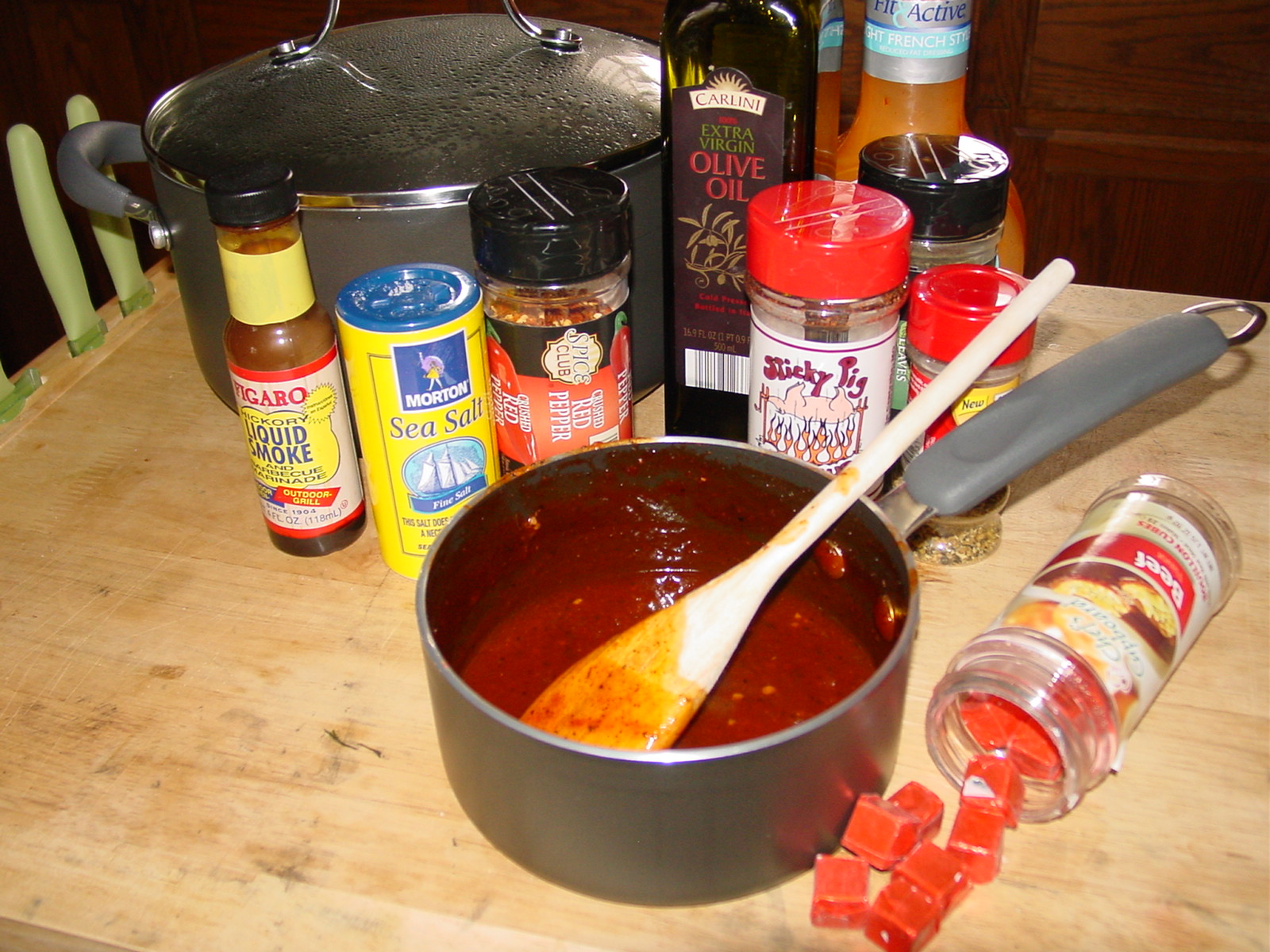
What do you get when a bored pork lover stands in her kitchen contemplated what to do with this huge roast she has sitting on the counter and just for fun starts pulling miscellaneous items out of her fridge and cabinets?

First, you get an interesting, yummy smelling sauce, which is brought to a boil and allowed to simmer for a few minutes. 


Next, you get a large pork loin searing in a big pot with some e.v.o. oil.

 I just love bubbling oil.

 Then, that same bored pork loving cook slathers the seared pork loin with the steamy goodness of the previous concoction.
Mmmm...

Bake to 160 degrees.

And, Voila! A yummy, juicy, delicious hunk-o-loin.

Monday, December 27, 2010

Sustainable Pork

Here's a little something I put together showing just one of the many cycles of pork production. Enjoy.


Jump over to my YouTube channel The Bacon Cam to see more videos on modern pork production.

Friday, December 10, 2010

More on Advocating Agriculture

Recently, an article in Pork Network's newsletter was brought to my attention regarding how important it is for farmers and ranchers to "open up" to the public. Too often we forget how fortunate we are to be part of this amazing process called farming. However, we must keep in mind that 98 percent of this nation are not connected to agriculture other than what they see, read, or hear in the media or on the Internet. In this day and age of animal rights activists attacking animal ag and consumers' increasing concerns for the environment we need to put ourselves out there in order to help educate the public. They will not understand what we do or how we do it if someone does not take the initiative to educate them.

On that note, here is an agvocating recap:

In a previous post, Agvocating is Essential  and in a Suite101 article, Agvocating: Harvesting Social Media I highlight some of the basic ways to advocate agriculture but I would like you to keep in mind, you do not have to be a full time farmer or farm hundreds of acres to agvocate. You could blog about your neighbors' farm (with their permission, of course). This is not only a great way to learn about farming for yourself but also to get to know your neighbors better. You could blog about your gardening and the local farmer's market. You could keep up on Ag news and post your own commentary about recent headlines. You could even blog about your own questions, concerns, and curiosities about agriculture and then follow up with what you have found out. The blogging possibilities are endless, just use your imagination and start typing.


Videos are an amazing way to agvocate. They can be serious and show specific aspects of farming or...


They can be a bit goofy (maybe even dorky) while still making a point.


Videos are a huge part of agvocating because YouTube gets so many hits and you don't need to be an award winning director to produce a great YouTube video. In fact, it has been my experience that people prefer the rough-around-the-edges approach. Think of how huge reality shows have become and it makes sense, people want real life. You don't have to be doing anything exiting either. Keep in mind the daily chores you find mundane are actually fascinating to the masses because it is all totally new to them. Just film your cows grazing, someone throwing feed to pigs, or milking a cow, just about anything will work. If you don't have a YouTube account they are really easy to start and your information is kept secure, only the info that you allow will be available to others. If you've never uploaded a video and don't know how I'll bet your kids, grand kids, or the neighbor's kid could help you out. You can also leave me a message in the comments and I can try to answer any questions you may have or at least direct you to someone who can answer your questions.

Take a look at the BaconCam Channel for some more video ideas. What do you do to agvocate? What videos would you like to see about farming? Do you have an Ag blog you would like to share? Leave the link in the comments.

Thursday, December 2, 2010

There's A Pig in My Bacon

As a Missouri pork producer, family farmer, mother, wife, and concerned consumer I feel it is my duty to call to your attention the frightening and somewhat ridiculous fact that the American people do not realize bacon and ham come from pigs. Shocking as this may seem, it is the only explanation that I can come up as to why the purchase of pork steak, pork roast, pork loin, pork chops, pork etc. drastically declined during the 2009 so-called "swine flu" panic, while bacon and ham actually increased in sales. Alternatively, since those products didn't have the word "pork" in their name, consumers may have felt that that particular section of the hog was unaffected by the flu virus. Not that you can get the flu from eating meat, unless of course, someone sneezed on it but this could too be the explanation, however unlikely.

I also feel that as a writer and agvocate (ag + advocate for those of you who don't tweet) I have a moral obligation to shed some light on the subject of swine. It is my moral duty to tell the world--or at least the American public--that there is, in fact, a pig in your bacon. The people have a right to know and I will uphold that right. Not only am I proclaiming the truth of your bacon's origins, I am going to tell you how that pig got in your bacon in the first place. The people need to know and it is high time the truth was told straight from the hogs mouth.

Stay tuned for more on this developing story...

Monday, November 15, 2010

Manure Management

Photo of Anhydrous Ammonia Tanks

It's that time of year again. The crops are out, the ground is worked, and now the fertilizer must be spread in preparation for next years crop. This is where manure managment comes in.

The dominate fertilizer is anhydrous ammonia. This is a chemical fertilizer that injects nitrogen into the soil, which is needed to grow corn. However, there is another option, manure. Not all farmers have access to manure; furthermore, despite the thousands of CAFOs in America, we just don't make enough manure to go around. Our farm, and a few surrounding farms that contract us to fertilize their fields, are the fortunate ones because we have the best fertilizer you can get--Pig Poop!

Image of slurry wagon knifing
manure from a swine CAFO

Not only does manure significantly cut costs by $30 to $50 per acre, it also rebuilds topsoil. Since hog manure is a natural fertilizer made of organic materials it does more than just inject a specific nutrient, it puts back what crops take out creating soil that will, over years, need less fertilizer to maintain high yields.

Many anti-CAFO people believe that we are polluting the water and destroying the environment but we are actually doing the opposite. By reduces the use of petroleum-based chemical fertilizers and replacing them with the original fertilizer that our grandparents, great-grandparents, and generations before them used we are created a safer, healthier environment.

As long as farmers follow the rules and regulations set by the Environmental Protection Agency (EPA) and enforced by the Department of Natural Resources (DNR) we are doing our part to remain good stewards of the land, which is what farming is all about. We take care of what takes care of us.


See manure in action on YouTube by watching the latest video on the BaconCam Channel,

Monday, October 25, 2010

Missouri Cares--Vote NO on Prop B

I would like to share an email I received last week. It caught me by surprise and I thoroughly appreciated it. This email shows the level of dedication Missouri's legitimate pet businesses have and how serious they are about their job. One of the major issues we are having right now with Prop B is that radical groups are trying to paint every puppy breeder as being a "puppy mill." This is the same as labeling our family farm a "factory farm," which just isn't the case. Just because we're big doesn't make us bad, same goes for puppy breeders. Furthermore, people like Tonya, who buy puppies from legitimate breeders, are being chastised as well.

Hi,


My Name is Tonya Thoenen and I own and operate a small pet store outside of Mexico MO. Puppy Love Haven has been in business for 28 years . I love my job providing quality puppies to mid Missouri and providing children with their first pet (best friend) or an elderly person finding companionship after they have lost their loved one. This is better than being Santa Clause! I know in my heart they went home with a good healthy dog that will love them unconditionally.

I purchase puppies from several licensed kennels in Mo. and have first hand knowledge that this is their livelihood also. We don’t do this as a hobby. Its in our blood. The dog breeders I know are passionate about what they do. This is a blessing from God to love what you do. I know for a fact that you will not find one livestock farmer or row cropper or dog breeder that hates their job.

Thank you for coming to the 4 H meeting and all of your well written blogs. I forwarded your site to my Mo. inspector to read. I know she will like it and appreciate it. It took me awhile to figure out how to thank you, I'm over 40 and don't have any children to show me how to respond to a blog. (smile)

So in closing. Thank you for your support, thank your for your information. I had no idea how much I rely on pork products. Where would we be without our pork?

God Bless and have a great day.

Thanks, Tonya Thoenen
Puppy Love Haven
573-581-6433

Missouri has been labeled "the puppy mill capital" by HSUS and ASPCA. These same radical groups have pushed Prop B onto Missouri's ballot claiming it will end puppy mills, claiming it will stop puppy cruelty. But, I'd like to know how? Prop B does nothing to enforce the laws, it does nothing to improve the laws, it basically does nothing but put HSUS's foot in the door to legislate animal businesses out of Missouri.


Thank you Tonya for caring. Thank you to all the legitimate and responsible puppy breeders that provide healthy pets to loving homes. Please help keep these people in business and don't let misleading ads by radical groups stop us from having pets. We don't need more government to protect animals, we need help enforcing the laws that we already have. If HSUS and ASPCA really cared they would have spent the millions they have wasted on this campaign on actually helping animals. They push the ballot but don't pay the bill. Prop B won't help Missouri.
 
Vote NO on Prop B. 

Friday, October 22, 2010

A Barn Called CAFO **Part Five**


How is it possible for these operations to have a small carbon footprint?

All concentrated animal feeding operations are required to have a nutrient management plan not to mention the vast array of permits and regulations. This nutrient management plan is created to follow specific state mandated requirements. It details amounts of waste produced daily and annually for each site and how that waste is to be utilized. The technological advances in farming provide several options, too. Waste can be used the traditional way, as fertilizer, it can be used to create energy from the methane gases, or the waste can go through a treatment system similar to any town or city’s waste water treatment facility.
As far as their carbon footprint, animal agriculture only contributes 2.8 percent of the U.S. Greenhouse Gas Emissions (GHG) and pork production is even less. Hog farms contribute a mere 0.33 percent. That is only one-third of one percent--people produce more GHG than that. New technology and a greater knowledge of environmental impact can be contributed to this small percentage. Such practices as recycling hog waste as fertilizer and using a smaller land area to raise more pigs is another contributor to making the pork industry a green industry.

The pork industry doesn’t just provide meat and fertilizer, though. There is so much more. An entire world of products come from pork. In fact, over 500 byproducts come from pigs. The plastic that my freezer is made of, the freezer that holds all those frozen hunks of pork, perhaps that came from a pig as well--plastics are pork byproducts. The chewing gum that has become my latest habit/addiction is a pork byproduct. Everything from glass to glue, from rubber to crayons, and if I wore make-up, I could thank a pig for that too. Antifreeze, linoleum, weed killer, insecticide, water filters, the list goes on and on. Yet, people want to rid our country of this vital product, this irreplaceable commodity and for what? For misguided morals, religion, or because someone else told them that’s what they want? Why?

Why would you not want the pork industry to keep up with the demand? Why would you not want pork, period? Pork is one of the healthiest meats next to fish. In fact, according to the Pork Checkoff and National Pork Board pork is even healthier than chicken in fat, calorie, and cholesterol content. With 40 percent of the world’s meat being pork and over 500 byproducts from these amazing animals the demand is astronomical. New technology that allows pork to be produced quickly, efficiently, and safely are necessary especially in these competitive times. That is were CAFOs come in and that is what CAFOs do. They create supply to meet the demand safely, efficiently, and economically while creating jobs and allowing family farmers to stay on the farm.


Finally, after contemplating the importance of animal agriculture and the pork industry then writing about it, I decide tonight is definitely a pork steak night. I reach through the icy fog until my fingers find the heavy thick package with “PORK STEAK” stamped on the top in bold black ink, slightly smudged. Up the stairs I tromp, still pondering our fortunate circumstances, reminded of a time in my life when I had to skip meals to make sure my kids had enough to eat. The time we had so little money that I went without, though I never starved, I did fight hunger pangs on a daily basis.

Unwrapping that pink and white marbled meat, I give thanks to the barn down the road that supplied us with this meat. A barn that houses nearly 5,000 pigs. A barn that helped the local community by the vast amounts of property taxes paid. A barn that stirred so much controversy that a town meeting was called just to settle down the community to little avail. A barn that housed the thousands of  A barn that is called a CAFO.

Well, what did you think of my five part series, A Barn Called CAFO? As always, the comment box is open.
Thursday, October 21, 2010

A Barn Called CAFO **Part Four**


According to the American Veterinary Medical Association (AVMA) and the American Association of Swine Veterinarians (AASV) individual housing has its advantages. By utilizing a stall system large enough for one sow it minimizes aggression and injury, reduces competition for resources, allows individual feeding, which assists in controlling body condition, and provides safety for the workers. The disadvantages, however, are restriction of movement, exercise, and foraging behaviors and it limits social interaction.


Some sow barns utilize group housing. This type of housing allows freedom of movement, exercise, and social interaction; however, gestating sows tend to be aggressive when around others which leads to injuries for both sows and workers. Also, without individual feeding swine have uneven and in some cases unhealthy body conditions. It would be nice to keep pigs in slop-filled pastures, keeping with that 1930’s picturesque farm scene but the acreage just isn’t there.

With a concentration of this many animals in one building waste management is a concern. One small barn of only 1,200 head produces more than 1,500 gallons of waste per day. With more waste than pigs, consumers’ rising concerns for environmental safety, and concerns for reducing our carbon footprint it is obvious why consumers are concerned. These facilities, which store so much waste, must be pollution havens; not to mention, have an enormous carbon footprint. Actually, they don’t.

To Be Continued...

Wednesday, October 20, 2010

A Barn Called CAFO **Part Three**


So, how do CAFOs work? More importantly, why do we even have them?

To answer these questions you need to consider practicality along with functionality. Because of the increasing demand for pork, the most widely eaten meat in the world, swine farming has had to evolve to a faster, more economic way of production. Despite the deceasing amount of rural property available, hogs are still pasture-raised. However, to keep up with the high demand for pork, another more productive method is being used in the U.S., Canada, and around the world--CAFOs.


One misconception is that these large operations are putting small farmers out of business, quite the contrary. Some companies actually contract small farmers to raise company-owned hogs in farm-owned buildings on farm-owned land. That means small farmers are able to maintain their land, expand their business, and have financial security in an economically insecure time. These buildings not only supply farmers with a steady paycheck, they also supply the farmer with a natural, renewable fertilizer that works toward rebuilding topsoil instead of just injecting more and more petroleum-based chemicals year after year like anhydrous ammonia.

These buildings are also fully automated and climate controlled. That doesn’t mean it’s like your slow cooker, you can’t just set it and forget it. Hogs are a 24-hour a day, 7 days a week occupation. The automation just makes the job somewhat less difficult. The temperature, humidity, lighting, feed, and water are all monitored and automated to maintain the ideal condition for optimal health and comfort of the pigs. CAFOs have automated heating, cooling, and ventilation systems; there is also a security feature in the computer system. If the computer senses a problem with any of the automated functions, an alarm will go off notifying the farmer of the problem via cell phone. The barns even have generators in case of power outages.

There are a few different types of swineherd operations and they range in size from 1,200 head to more than 10,000 head. One type is farrow-to-finish; these operations handle it all from the gestating sows to raising the piglets to market weight. A farrow-to-feeder operation only handles sows and piglets and a feeder-to-finish handles the weaned piglets and raises them to market weight hogs. Once piglets reach feeder size and are weaned they go to an open barn with large pins called group housing. This allows plenty of movement and socialization but that’s not where the concern lies, it’s the farrowing stalls that ruffle feathers.

What does the American Veterinary Medical Association (AVMA) and the American Association of Swine Veterinarians (AASV) have to say about these stalls?

You'll have to come back tomorrow to find out...

Tuesday, October 19, 2010

A Barn Called CAFO **Part Two**


So, what is a CAFO?

I’ll be honest, I can only answer that question as it pertains to swine CAFOs because that’s what we have and that’s what I know. Of course, many will brand me a hypocrite because I complain about biased information yet I am advocating the very business that feeds my family but I do have an outside view. You see, I wasn’t raised on a farm; I married into one. I didn’t know much of anything about the pigs until the farm expanded and my husband went to work with the rest of his family. I have the luxury of seeing this from both sides of the fence and I’ll admit, sometimes even I am conflicted.


The conflict doesn’t come from the CAFO as much as it does from the idea farming conjures. Farm life makes you think of red barns, wire fencing, green pastures, tractors, and an assortment of livestock but that was 40 years ago and this in now. Though, one aspect of farming has stayed the same but has been lost in translation--the business of farming. Farming is a way of life, farming gets into your blood, is passed from generation to generation but it is also a business and businesses need to make money. Businesses must also change with the times or face being put out to pasture. CAFOs are a marriage of farm values, business ethics, and modern technology.

So, how do CAFOs work? More importantly, why do we even have them?
 
Read more tomorrow...

Monday, October 18, 2010

A Barn Called CAFO **Part One**


Standing in my basement staring at the abundance of frozen, plastic wrapped hunks of pork, wondering what to fix for dinner, it occurs to me how blessed we really are. We live paycheck to paycheck like most Americans, we don’t have anything more than the next person does, and money gets tight around the holidays especially; but I still consider us happy, blessed, and overall well off. It is so easy to forget how fortunate my family is during these rotten economic times. I take for granted, like most, the abundance of food we enjoy, not just as a family, as a nation. I don’t think about where my next meal is coming from. I don’t wonder how I am going to feed my children. I just stare into the frosty abyss and wonder, “Which hunk of meat should I defrost or should we order out for pizza?”

In this country, where people have grown accustom to having plenty but wanting more, we have lost sight of what is really important. Food on the table is expected, plastics, make-up, even weed killer and insecticides are considered necessities instead of luxuries. But does anyone stop to wonder how those things get to your table, home, or even the stores? Does anyone stop to think that maybe, just maybe animal agriculture has something to do with it? Has anyone thanked a farmer lately? Maybe they should.

****

Concentrated Animal Feeding Operations better known as CAFOs, notoriously known as “factory farms” seem to be the devil these days. Look at the media and you’ll find mostly negative articles, biased information, or flat out misinformation. We have radical vegans shouting that we don’t need animal agriculture. We have radical animal rights groups seeking to legislate agriculture out of this country. Have any of these groups, these people considered what CAFOs truly are or how they actually operate? Have they considered what they contribute?

If you want a technical definition, the Environmental Protection Agency, EPA, has one to offer: Concentrated Animal Feeding Operations are farming operations where livestock, greater than a specified number, are kept and raised in a confined situation and on a small land area. Feed is also brought to the animals rather than the animals grazing or otherwise seeking out food. Unfortunately, that doesn’t really define anything. The EPA’s definition is a bureaucratic way of saying there are a lot of animals in a smaller area. But everyone already knows this much.


So, what is a CAFO?
 
Find out tomorrow...

Tuesday, October 12, 2010

Porky Products

With all this talk about Prop B, "The Puppy Mill Bill," or whatever name it wants to go by, I've lost site of what month we're in. Not only does October hold one of my favorite holidays, no it's not Columbus Day, it also happens to be National Pork Month. I'd like to take a little break from the "Vote No to Prop B" campaign to discuss my favorite farm animal...Pigs.


Many, but not all, vegans, veggies, and animal activists believe we do not need to consume animal flesh. To them, consuming animal flesh is morally wrong and down right icky. Those same folks go on to proclaim that we don't even need animal ag, we should rid this country of animal business all together. Well, that is all fine and good with me if they don't want to eat meat but what about the other stuff?

What other stuff? you might ask. Well, pigs aren’t just for ham and bacon. There are over 500 byproducts that come from pigs that has nothing to do with their meat. This is true for more than just the pork industry, every animal industry has a slew of byproducts that we use in our everyday lives.

If you are one of those that wish the animal ag industry to fail or at least tuck tail and run, then you better be prepared to lose many common items or at least be willing to pay through the nose for them. Because we would have to come up with another way to produce these products without the animals and that would require man-made replacements that most likely will come from fossil fuels.


Here are just a few of the 500 plus products that use pork in either the manufacturing process or in the making of the product:

Glass              Chalk                 Glue                              

Crayons          Buttons              Fertilizer                       

Insulation        Weed Killers       Plastics                         

Fabric Dye      Ornaments          Insecticides

Matches          Upholstery          Floor Waxes                 

Rubber            Water Filters      Antifreeze                     

Make-up          Linoleum           Chewing Gum              

Cement         Gelatin (this includes jell-o and marshmellows)                         

Asphalt (They used this one in St. Louis)

And you thought pigs were only good for breakfast. Just think of all the products that rely on the pork industry. Then, re-think your position pertaining to the importance of animal ag in Missouri and the U.S.A.

See me on YouTube in a goofy little skit called Porky Products.


Saturday, October 9, 2010

Vote NO on Prop B

I heard a frightening statistic today. Currently, voters are sitting at a 70/30 mix on Prop B. That is 70 percent wish it to pass and only 30 percent wish it to fail. I am one of those 30 percent; in case the title of this blog wasn't obvious enough. That tells me that an overwhelming amount of people do not understand the consequences of Prop B, also known as "The Puppy Mill Bill." This bill is playing on peoples emotions while conveniently clouding over the facts.


Click to enlarge.

This proposition states it is for "domestic animals," livestock are domestic animals. The language is vague enough that if passed, all it would take is one little amendment to change "dogs" to "livestock" and good-bye animal ag in Missouri. This bill, if passed, will put licenced, legitimate breeders and farmers out of business and only leave unlicensed and substandard breeders that stay just under the radar in business. Tell me, how does that help animals? This proposition, if passed, will lessen the required care for animals compared to the current law and regulations. Tell me, how does that help animals? This proposition, if passed, will eventually put tens of thousands of people out of work and out of business; not to mention, the prices at the grocery store will sky rocket just as they are doing in California right now because of a similar proposition.

Prop B limits how many animals dog breeders can have which would limit their income. Is that fair or right? Is that even American? Would you stand for someone telling you that you are only allowed to earn $10,000 a year by law? Because if Prop B passes that is what will happen to legitimate dog breeders. Not all dog breeders are "puppy mills." This is a derogatory slang term that is in the same category as "factory farms." The term is used to conjure the mistreated animals you see on TV but those few that mistreat their animals are not the norm. In fact, we, as farmers and breeders, want those places to be put out of business. We want those people to suffer to the fullest extent of the law. We own large confinement barns that are classified as CAFOs but we do not run them like an assembly line. Nor do we mistreat our pigs like HSUS and other radical groups would lead you to believe. We are not a "factory farm," we are a family owned hog farm.

Those 70 percent of you that wish Prop B to pass, have you read it and compared it to the current law? If you haven't you should. Please, do your research before you step up to the voting box. Please, look at the facts instead of letting HSUS use your emotions against us all. Animals are already protected by state laws. Prop B is not about protecting puppies, it is about putting animal ag and breeders out of business.

For those of you that think that we should all be vegans and abolish animal ag, remember this is a free country. No one is forcing you to eat meat so do not force us to not eat meat. Also remember that over 500 products are made from pork alone. From plastics to make-up. Stay tuned for my Porky Products post on Tues., which is about pork byproducts and re-think where you stand on animal ag.

Prop B is only a stepping-stone toward a meat free society. Do the following quotes sound like something that would come from a person who loves and cares for animals?

“We have no problem with the extinction of domestic animals.”-Wayne Pacelle, President, HSUS

“In fact, I don’t want to see another dog or cat born.”-Wayne Pacelle, President, HSUS

“Our goal is to get sport hunting in the same category as cock fighting and dog fighting. We are going to use the ballot box and the democratic process to stop all hunting in the United States.”-Wayne Pacelle, President, HSUS


If you love your pets, if you love to eat meat, if you hunt, or if you want to keep your constitutional rights
Vote NO on Prop B.
(click on "Animal Care Toolkit")


Friday, October 8, 2010

Prop B Meeting

Last night my husband and I pulled into a full parking lot in front of Mexico's 4-H building. We were greeted by Mr. Middleton (he and his wife are Missouri dog breeders) who graciously held the door for us. Through the wide white door and off to the large room on the right we found rows of people tentatively listening to Cathy Griesbauer, President of Professional Pet Association, discuss the truth behind Proposition B. PPA President Griesbauer gave frightening HSUS statistics; for example, less than half a penny is spent on hands-on care and HSUS does not help or participate in any spay and neuter program. Yet they're suppose to be helping animals. Another interesting aspect to Prop B is the fact that current regulations on dog breeder are actually more strict and Prop B reduces the level of care for the animals. What Prop B is actually doing is creating it harder to have an animal-based business in Missouri.

One of the key points made is here in one of Cathy Griesbeaur's slides.

The next speaker to take the stage was Chris Chinn from the Farm Bureau. She explained how Prop B is a stepping stone for radical groups to change animal agriculture like they did in California. One of the major goals of HSUS is to create a meat free society and to give animals the same rights as people. Prop B is only step one of this initiative. Another key point made during her speech was that we as farmers need to tell our story. Radical groups are busy telling our story for us but it is the wrong story. We need to "put a face on agriculture" and make our voices heard. 
After Chinn's presentation the floor was opened to questions and comments. One of the audience members who presented his view on Prop B was Senator Bill Stouffer. Another political figure present was state representative candidate Linda Witte. This meeting was a success however it's not over. Another meeting will be held Tues. at Coach's Pizza in Mexico and we need every ones help to spread the word about Prop B's lies.

Prop B doesn't help animals, it hurts the economy, hurts local and legitimate businesses, and it is the first step to reducing if not removing your rights as an American citizen.

Vote NO on Prop B

Monday, October 4, 2010

More on "The Puppy Mill Bill"

Here are some scary statistics concerning the Humane Society of the United States:

  • HSUS is a national factory-fundraising nonprofit organization preying on the public's emotional attachment to pets; yet, gives less than 1% of their millions to local animal shelters.

  • $31 million of the public's contributions to HSUS goes for salaries and over $20 million is spent on litigation, lobbying, campaigns and legislation, even though HSUS is registered as a charitable organization--This information is from the Center for Consumer Freedom's analysis of the latest IRS paperwork filed by HSUS for 2008.

  • HSUS collected over $86 million in contributions in 2008 and in that same year spent $24 million on fundraising. In other words, 28 cents of every dollar contributed is used to raise more money.

  • HSUS is a radical group trying to abolish animal agriculture, sport hunting, and the ownership of pets. They are wanting to take away our rights not to mention the thousands of jobs created by agriculture, hunting, and pet breeding.
Bottom line, HSUS has already infiltrated Florida, Arizona, Oregon, Colorado, California, Maine, Michigan, and Ohio with their radical animal rights agenda. Do you want them in Missouri too?


I know I want to maintain my right to own my beautiful and beloved pure breed English Shepherd, Mina, that I bought from a breeder.


I want to keep my right to own and operate any business that I see fit on my own property because this is America. Better and braver men and women have died for the freedom we enjoy and I'm not about to let HSUS take those rights away from me all because they feel that "The life of an ant and that of my child should be granted equal consideration."
Not in my town, Bub!

Vote NO on Prop B!

Don't forget to mark your calender for the Prop B meeting. A speaker from the MO Farm Bureau will be there to answer questions and give the details on this issue.

Prop B Meeting
Thursday--October 7 @ 7 p.m.

4-H Center
21509 Hwy D
Mexico, MO

For questions call 573-581-0971 or 573-581-6433

For more information, visit:

(click on "Animal Care Toolkit")

Saturday, October 2, 2010

Pork Trivia


 Missouri ranks 7th among all the states in pork production producing 6% of the U.S. Pork.


 In 2006 the pork industry created nearly 25,000 jobs.

 The pork industry contributes more than $1 billion dollars to Missouri’s economy.

 The biggest pig ever recorded was 5 feet tall and weighed over 2,500 pounds! That’s as big as a car.

 Pigs can’t sweat. They don’t have sweat glands.

 It only takes around 160 days to raise a pig to market weight of 220 pounds. That’s just over 5 months.
They sure grow up fast!

 A pig’s Squeal Can Reach 115 Decibels–that’s as loud as a supersonic jet engine. You better cover your ears when they start squealing!

 Pigs, both wild and domestic, eat fruits and veggies but they will also eat eggs, birds, rodents, even snakes. Maybe that’s why they’re called pigs.

Friday, October 1, 2010

Where's the Family Dog?

Who doesn't love a cute, innocent, big eyed puppy? What jerk would vote against a bill that would save these adorable creatures from a life of abuse? That is what HSUS wants you to think but "The Puppy Mill Bill" is a LIE!

If Prop B goes through the family dog won't be with the family anymore. If HSUS gets their way we won't have pets...or rights. Proposition B or better known as "The Puppy Mill Bill" is going to be on the ballot this November. So, what is Prop B?

Prop B has been pushed on the ballot by the Humane Society of the United States (not to be confused with your local animal shelter). This bill was designed to eliminate all dog breeding in Missouri. It will allow authorities to charge licensed breeders with a misdemeanor crime of "cruelty" if they have a cobweb in their kennel, a piece of food in a water bowl, a scratch on a painted surface, and this is only the tip of the iceberg.

Think I'm exaggerating? Read the fine print.

Prop B even reduces current regulations from 2 feedings per day to 1 feeding per day. These regulations pushed on us by the HSUS have already successfully shut down legitimate pork businesses in Florida, the egg industry in California, and now they are coming after Missouri. HSUS is shutting down legitimate businesses across this "free" country during a time when unemployment is skyrocketing. This radical group isn't for the greater good, they are for their own radical, selfish, illogical and irrational agenda that only hurts us all--including animals--and takes away our God given rights.

HSUS is a radial animal rights group, NOT an animal welfare group--BIG difference. Animal rights means they want animals to have the same rights as people do, i.e., you are charged for murder if you shoot a deer or charged with involuntary man(animal)slaughter for running over a squirrel. Just a tad on the radical side? I think so but if you're not convinced let's look at some quotes straight from the horses mouth--so to speak.

Wayne Pacelle, President of HSUS, Associated Press interview:

"If we could shut down all sport hunting in a moment, we would."

Another quote from Wayne Pacelle:

"I don't ever want to see another dog or cat born"

John Goodwin, HSUS grassroots coordinator, statement made on AR-Views:

"My goal is the abolition of all animal agriculture."

Michael W. Fox, HSUS senior scholar, Associated Press interview:

"The life of an ant and that of my child should be granted equal consideration."

Vote NO on Prop B on Nov. 2

To learn more about Prop B visit TheAllianceforTruth.com and join us at a town meeting in Mexico, MO

Prop B Meeting

Time & Date:
Thursday--October 7 @ 7 p.m.

Meeting Location:
4-H Building
21509 Hwy D
Mexico, MO

Speaker:
Missouri Farm Bureau

Questions:
573-581-0971 or 573-581-6433

Monday, September 13, 2010

Swine Time on YouTube

Well folks, the Bacon Cam has struck again. Recently, I was asked about swine boredom and around that same time I had read some studies done on the "complex emotions" of pigs. These concerns inspired me to videotape a little "toy" that we give pigs to play with in the barns. Take a look at our latest YouTube video, Entertaining Swine, and let me know what you think.


What kind of YouTube videos would you like to see?

Sunday, July 18, 2010

Hold On To Your Hams--Exciting News

Great news!! The Bacon Blogger has now been viewed in four, count 'em, four countries. But that is only part one of my exciting news. What is part two, you may ask.......

THE PIGGIES ARE COMING!!! THE PIGGIES ARE COMING!!!

Yep folks, our piglets will be arriving tomorrow and we can't wait. I even took a few days off work so I could help with the piggies. Our kids are looking forward to playing with the little snouts too.

Hold on to your hams folks, that's not all!!! There is a part three.....


Photo courtesy of PorkConnection

We will be introducing the BaconCam to YouTube in the next few days. Don't worry bloggers, I will provide a link to every video. The BaconCam will show tours of the farm and the ins and outs of hog production. Everything from how we feed them to what we do with the feed after it comes back out of them. We want to share the process with you all so everyone can see what it takes to get that bacon on your BLT.

Photo from Amazon.com

Phew! I can't take this much excitement.

Do you have something special you would like to see on the BaconCam? Drop your suggestions in the comments section and we will do our best to show what you are most curious about. See you on the Flip side.

Sunday, July 11, 2010

First of Many Photo Farm Tour

Have you ever wondered what the inside of those big white barns with the giant fans look like? If you haven't seen one yet or if you've only seen what anti-aggies have posted, here's your chance to see the real deal from a real family farmer. I will be starting a little photo tour of our barn so everyone can see the process of raising pigs. In this first one the barn is empty to show how clean it is before the pigs come in. You can also see the shear size of it, this thing is huge.
Here are a few pictures to show the length of this barn. It's a heck of a long walk to the end!
Before every group of new pigs we have our barns power washed and disinfected to ensure that our piggies come into the cleanest environment possible. We also take this time to do work on the barns, repairing what needs be repaired and performing routine maintenance on the barns. Once we're done cleaning this barn it is cleaner than most homes! Doesn't it look brand new?

This is my husband, Aaron. He's fixing the water lines using his carpenter stilts. Beats a ladder!

Soon the baby piggies will be here and we can't wait to show them to you! I'll keep you updated bloggers.