Tuesday, August 7, 2012

Family Farm vs. Factory Farm

 vs.
Image from farmamerica.org
Image of hog barn from our farm
      

I’m no writer but here’s my thoughts on this whole family farming vs. factory farming thing. People have this idea that the “traditional” family farm is ma and pa with 50 pigs out back and a big red barn because that’s the way farming use to be so that’s the way it is today. But the thing that we need to tell people who have that idea that a big farm can’t be a family farm is that the family farm is still the same it has just changed its looks. We had that little ma and pa type farm but it couldn’t support one household let alone four like it does today. By going bigger and using these hog barns we are able to grow the family business and now the whole family works on the farm. We are even taking better care of those pigs and they spend their days a whole lot more comfortable than I do especially in this Missouri heat. The family farm is still the family farm no matter what size it is but it just looks different and that is not a bad thing. We’ve made lots of improvements and we continue to look for better ways to farm. But this is what we do and how we do it and we are proud to be farmers.

Wednesday, August 1, 2012

Preparting for Portland & IFBC 2012


As an active agvocate, I am always happy to share my story. So, you can imagine my excitement when Teresa from the National Pork Board contacted me about a unique opportunity. The National Pork Board is sponsoring a breakfast at this year’s International Food Bloggers Conference, which will give food bloggers a chance to talk directly to hog farmers and learn more about modern pork production. Well, since we are simply Hog Wild about farming I was all too happy to say YES to this great opportunity to meet new people and spread the word of AG. The IFBC 2012 is being held in Portland, OR this year so that makes it even more exciting for two reasons: 1) I have never been to Oregon; 2) This is a rare chance to connect with people (particularly foodies) that I normally would never encounter. I believe between the Pork Board’s efforts and that of the U.S. Farmers and Ranchers Alliance we are definitely on the right track to an open dialogue between farmers and consumers. There is a communication gap between the people that raise food and the people who only see the end result. This gap must be closed in order to not only improve farming but improve the way people think about farming. Never have people felt so removed from the farm and this is why, I think, there is such uproar over farming practices. While farming has improved over the decades we are still learning and it still has a long way to go; however, farming will never reach its full potential if we do not connect with the people that depend on us. Farmers know the land, they know their animals, but they don’t know everything and it is easy to become jaded and lose sight of the bigger picture. This is why we need to open the lines of communication on both sides of the gap. We may not agree on everything put if we at least have an open conversation about it we stand to learn more than we ever thought possible. Each side has legitimate concerns and each side thinks they know better but how can we improve if we never look at the other side? There is more than one way to farm and that is what makes farming fabulous—it’s diversity.

The main topic of this breakfast panel is the We Care Initiative and how we use it on our farm. This may sound like a slogan to some but for pork producers it actually means something. Here is a video that gives a sample of what the We Care program means:


I am looking forward to speaking with all the chefs, food bloggers, agents and editors, cookbook writers, and otherwise food curious folks in Portland. I am hoping for an enlightening and enjoyable conversation about food, farming, and the yumminess of pork. Hope to see you in Portland.

Are you going to this year’s IFBC? I’d love to hear from you!

Sunday, July 29, 2012

Factory Farms: An Issue of Scale

Factory farm or family farm?
As a concerned mother, wife, and fellow consumer I can understand how the idea of a “factory farm” can scare, anger, or even confuse the general public. However, as a farmer’s wife and pork producer I must ask what is a “factory farm” anyway?

I have found through reading blog posts, tweets, and FB comments that the biggest defining factor for “factory farms” is an issue of scale. The bigger the farm the more likely it will be categorized as a “factor farm.” Technology also plays a role in people’s perception. The more we utilize technology the more we are all lumped into a corporate farming pile.

But does a larger scale of farming make you a factory/corporate farmer or a successful/sustainable farmer?

We raise 26,000 pigs over the course of a year plus several hundred acres of corn and soybeans. We utilize modern farming techniques to make us more efficient, safe, and environmentally friendly. Because we are larger in scale and have modern techniques does that make us factory farmers or successful farmers?

Fertilizer--knifing hog manure
We also participate in contract farming. We contract pig space and have manure spreading agreements with local farmers. This means that we “rent” pig space in our barn and—as a family—raise company owned pigs in our family owned and operated barns. The manure spreading agreements help fellow farmers reduce fertilizer costs while still putting needed nutrients into the ground in the form of a natural fertilizer. By farming in this way our farm has grown large enough to support four separate households—all of which are family members. So, are we factory farmers or family farmers?

I suppose the biggest issue here isn’t scale, technology, or even technique; instead it seems to be a matter of perception. The original 50 acre farm with a few dirt hogs wasn’t enough to maintain a growing family and by utilizing modern farming practices we were able to grow in size and support four separate family households.

To me this says successful farming because it is done responsibly; however, many don’t agree with that. It would seem there is a double standard in farming. If any other business grows in size over the course of years and is able to employ more people it is seen as a successful business and the business owner is considered to be living the “American dream.” However, if we place a farmer in this same scenario the farmer is considered a “corporate sell-out” or “factory farmer” instead of being seen as successful. Why is this? Why can’t farms be large in scale but still maintain family values and ownership?

So I ask again: What is a “factory farm” anyway?

Tuesday, July 17, 2012

Post-Fair Finally


The ham sale was a success. Miss Kylee made out like a bandit (a very grateful bandit). A big THANK YOU goes out to Bob Cope with Mid-MO Truck and Trailer.

THANKS BOB!!!

Curing of the HAM

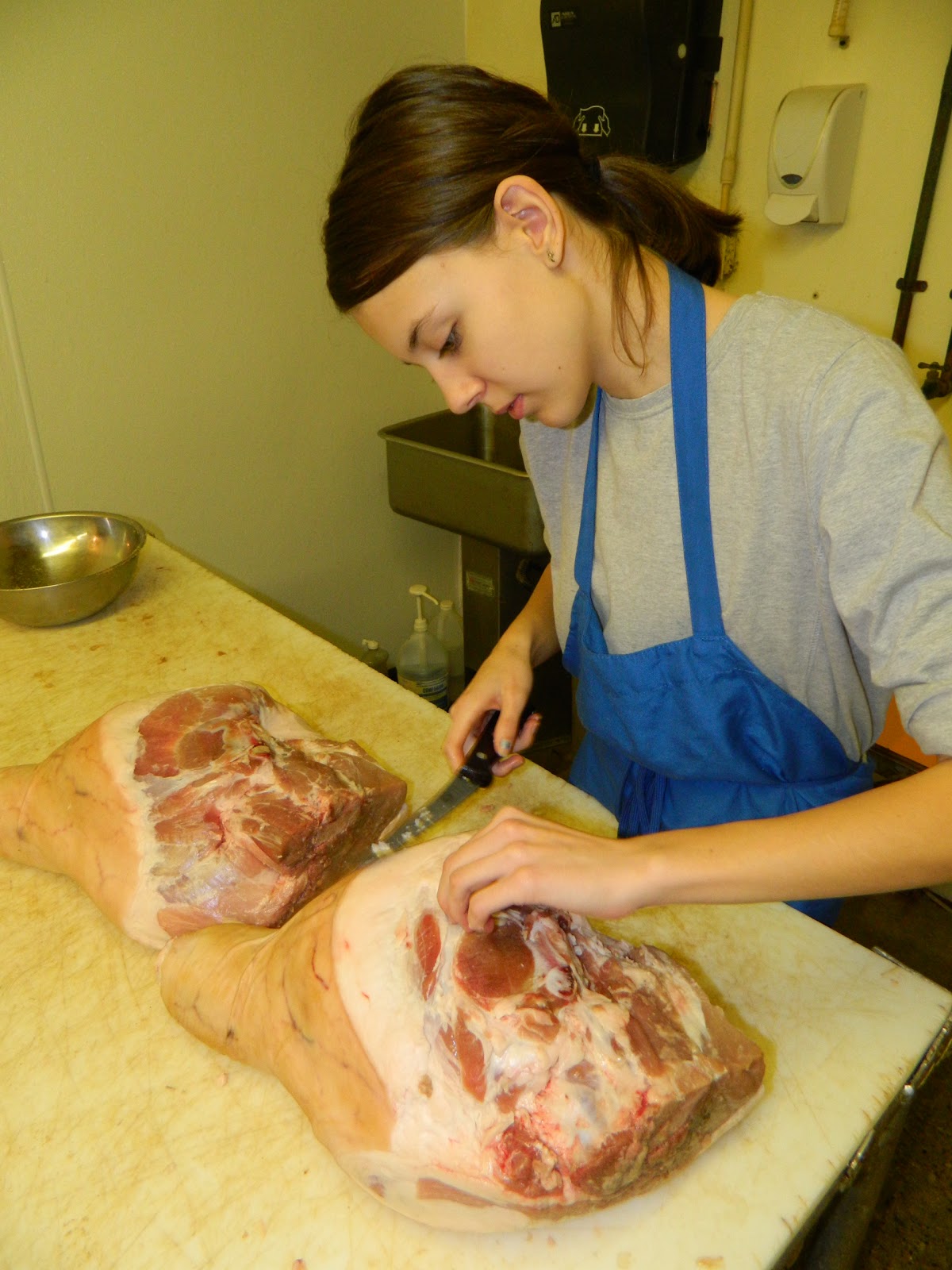
The 4-H county fair is here again and this year is no different from last year...we country cured a ham. It is amazing to think that our grandparents had no choice but to cure hams (that is if they didn't want them to spoil) but we now only do it by choice. We truly have come a long way but despite all that I believe that curing hams is still a valuable skill and a great reminder of how good we have it.
Kylee worked hard on her hams.

She trimmed them with loving care.


And smoothed down fat with a smile.

Adding the cure it is always her favorite part. She needed a little help from our friends over at 4 Quarters Perry Locker but once she saw Kristen do it she remembered how to stuff a hock.

And stuff she did.

She enjoys stuffing the hock a little too much but that's just my opinion.

After a good trim, a lot of cure, and some pretty wrapping paper the ham is ready for hanging...at least 5 months of hanging.

It is amazing how this bloody, fatty, hunk of meat turns into...

This blue ribbon deliciously smokey country cured ham.

It smells so good she can hardly contain herself...goofy girl!

Tonight is the big sale. Wish Miss Kylee luck. Hopefully her ham sells well.


Sunday, July 8, 2012

Pig Care Priority

Pork producers are always looking for ways to better their farming practices and pig care is on the top of their list.


Several producers gathered for a pig care meeting. This meeting was not only a refresher course but it also introduced the producers to some new ideas to improve their practices.


The meeting focused on the importance of individual pig care despite the large numbers being raised in hog barns. Some creative methods were suggested to help produces with this task.  


No pork producer meeting would be complete complete without a pulled pork meal. Yum!


The whole Windmann crew was there, too.


Farmers are constantly changing and improving their techniques and pork producers are no different. We strive to take better care of our animals because we care about the product that we produce and the animals that we raise.

Wednesday, June 27, 2012

Piggy Predicament

While some may refer to our swine operation as a factory farm we do not have factory hours. While most people either enjoy a half day of work or no work at all on Saturdays, it's just another day to a farmer. What began as a day of laying irrigation pipe and doing pig chores became a frantic relay race with the clock ticking.

First, three pieces of irrigation pipe had been damaged. Of course, the guys don't find this out until they do a test run and discover some leaks. So, they have to take practically the whole thing apart, fetch new pipes, and put the whole thing back together again. This isn't a garden hose either, folks. We are talking about six-inch aluminum piping that literally runs over the hill and through the buck-brush all the way across the field. It's some serious chizz to take this thing apart and put it back together. So, what started as a be-done-by-two job ended up lasting until after four o'clock.

Here's where I come in:

There I was, minding my own business, preparing supper. Frozen burger paddies in one hand and a bag of charcoal in the other when my husband, Aaron, bursts through the door. He was in such a hurry that I don't even thing he put the truck in park before he leaped out. It was a tuck and roll situation.

Aaron:
What're you doing? What do you have going on?
Me:
It's after five, Aaron. I'm getting ready to fix supper.
Aaron:
What? Supper? No, we don't have time for that. Throw some snacks at the kids and lets go.
Me:
Huh?
Aaron:
I gotta pig emergency and I need help. Let's go. Have they ate?
Me:
The patties are still frozen in my hand. So, no. No one has ate.
Aaron:
Right. Throw some snacks at the kids and lets go.
Me:
I got that part. Calm down.

You can imagine how well the conversation went after that. So, instead of munching down some tasty grill burgars with asperagus and potatoes, the children had cold-cut sandwiches and I went without. The charcoal returned to the basement, feeling abandoned, and the frozen patties in my hand returned to their home in the freezer, feeling cold. Away we flew to the land beyond with shining white tin and lush flowing fields green (and brown, we really need some rain). Into the pigs we go.

At this point I still have no idea what the emergency is or even what I am supposed to be doing. I just slip into my fancy rubber boots and slide on my fashionable blue coveralls and hope for the best. Turns out that a feed auger in the barn needed to be repaired. So our job was to first manuver pigs around to get as many as we could out of the pin that the feed motor was in. Armed with pretty plastic sort boards we begin the hearding process. I have a huge bruise on my knee as a result of a 200 pound pig that decided he did not want to go the same direction as everyone else. Oh, well. No worse for wear. The second job requires Aaron to teader on a plastic bucket while he fights with some bolts and a heavy motor. My job during this is to make sure the remaining pigs in the pin do not chew on Aaron or his tools. Have I mentioned we are on slatted floors? That means anything you happen to drop is forever lost...like Aaron's pliers and his previous pliers and several bolts. I think there might be a cell phone down there too. Well, after everthing is replaced (luckily his brother showed up just in time to help hold the motor and what-nots) the pigs had feed again and Aaron could finally calm down.

All-in-all it was a good time...well, sort of but not really. The point is the pigs come first and we gave up our supper time to ensure the pigs got their supper time.

Farmers care about their livestock and that's the truth!

Friday, June 22, 2012

The Cent of Swine

This is a post that I feel needs revisiting because it is an important factor in the farming industry. Manure management is also an environmental issue and John Q Public needs to know more about the renewable resource (and money saving resource) that we are producing. Enjoy...

A lot of folks whine, cry, and complain about the smell of a hog house but let me tell you...that, my friends, is money you are smelling. Don't get me wrong, we aren't a bunch of suits snapping our greedy claws at every dollar we see; we are family farmers. That means family owned and operated but farming is first and foremost a business...no matter what kind of farming you do. Furthermore, which is better, natural or chemical? Well, when it comes to fertilizer, I'll take natural over chemical any day of the week.

I ran across an interesting blog post The smell of money from a blog I follow, Brumm Speaks Out. In his post, Mike explains the financial benefits of utilizing swine waste as a natural fertilizer. He also describes the nutrients found in hog waste. Of course, here at Bacon Blogger HQ we have always appreciated our manure but here is a mathematical breakdown excerpted from Mike Brumm's post:

The average composition of the manure in pounds per 1000 gal of manure was 60 pounds of nitrogen, 30 pounds of phosphate (P2O5), 35 pounds of potash (K2O), 7 pounds of sulfur and 1 pound of zinc.

At the same time, I’ve seen prices quoted for commercial fertilizer in the range of $800/ton for anhydrous ammonia (82% N), $600/ton for phosphate and $800/ton for potash. Applying these values to the above manure analysis, the manure is worth $42.80/1000 gallons as it is removed from the pit.

For a wean to finish barn, you get about 340 gallons of manure per pig space per year or a net value at time of land application of $9.25 per pig space. For a 1250 head facility, this is $11,560.

When applied at 180 pounds of nitrogen per acre (3,000 gallons per acre), this becomes 8.2 pig spaces per acre from a grow-finish barn with a total land need of 150 acres.

Now, to put this into perspective, I'll give you the scoop on pig poop. To use a chemical fertilizer it will cost a farmer around $200 to $300 per acre; whereas for manure, we only pay what it cost to run the machinery--which doesn't even come close to $300 per acre. We also apply manure for other farmers and charge a fraction of what it cost to use chemical fertilizers. Furthermore, according to recent Canadian research manure actually helps rebuild topsoil. I think we can safely say that manure isn't waste, it is one of the most valuable byproducts from pigs. And, with proper waste management it can be an invaluable renewable resource for farmers.

Here is another scoop on pig poop:

Tuesday, June 19, 2012

Mexico Ledger Pet Contest

So, I entered my Miss Mina in the Mexico Ledger pet contest. I don't generally enter in such contests but I thought what the heck. Mina seemed excited about it and I think she is pretty special so in she went.


She's come such a long way and grown so much. Just seeing what a lovely young lady she has developed into brings a tear to my eye.
If you think Miss Mina is as special as I do you can vote for her in the Mexico Ledger Pet Contest. I know I'll be voting everyday for my pretty girl.

Who's a good girl...Who's a good girl...yes you are...want a treat...some bacon...yes you do...want you bacon treat...

Don't tell me you don't talk like an idiot to your dog, too. Everyone does it and I'm not ashamed.