Wednesday, August 22, 2012

Michelle Obama + USDA = Hungry Kids

This is the face of a little boy who is not impressed and neither am I.

 My kids need some serious food to keep up with their seriously active lives.
 
I have bumped Aaron’s Wordless Wednesdays because I cannot be silent on this day. I cannot sit by idly while children across the country have rumbling tummies. I’m not talking about under privileged children nor am I talking about the starving Pygmies in New Guiney—I am talking about our children and the new school lunch program.
 
My active kids on their tire swing.
The USDA has made some major changes to the school lunch program and so far, a week into school, I have hungry children. The new school lunch program implements larger portions of fruits, vegetable, and whole grains. I have no problem with that, I love fruits and veggies. HOWEVER, it also significantly reduces the amount of protein to practically nothing not to mention the calorie reduction. My kids are very active. They enjoy time outside, play with their friends outside, my daughter enjoys track while my son just likes to run and climb on anything and everything. My children also have a very high metabolism. By offering a “one-size fits all” style of lunch that reduces their proteins, carbs, calories, etc. they are lacking the nutrients their growing little bodies need.
 
I am not opposed to healthier eating but dictating what they eat right down to the amount of ranch dressing they can have (my daughter refuses to except that the gunk in her cup was ranch dressing, she said it tasted more like watery mayo) is not only ridiculous but it is doing more harm than good. Instead of starving the kids in an effort to control childhood obesity why not encourage more activity in conjunction with a healthy, FILLING diet. My daughter eats like she will never see another meal again yet remains a beanpole while my son eats like a bird and swears he is so full he will pop. However, my two very different children are offered the same amount of food at school. This does not play out well.
 
For example, I had high hopes for the new school lunch program because it promised to be healthier and the menu really looked good....on paper. We gave it a try. I hoped for the best and here's what I get: 
 
Today I asked my son, "How was lunch?" 
He said, "I guess it was ok."
Me: "Did it fill you up?" 
Him: "I guess so."
Me: "Are you hungry now?"
Him: "I feel pretty snackish."
Me: "Ok. Get a snack and let me talk to your sister."
So, I asked Kylee, "How was lunch?"
Kylee: "Ok."
Me: "Did it fill you up?"
Kylee: "NO! Two hours before school was out it felt like my stomach was digesting itself. I am soooooo hungry. Can I please take my lunch tomorrow?"
 
Both my children understand that a healthy diet is a balanced diet and everything is best in moderation. I also regulate how much my kids are on their DS's, Wii, and their TV time. They play outside, they stay active, and they need more food than USDA and our first lady is offering.
 
The new food regulations not only go so far as to regulate the amount of condiments a child can use but it also leaves schools with their hands tied. If a school chooses not to utilize this new program they will have their funding cut and then everyone goes without. Schools have been feeding us for generations and it feels like a smack in the face to all those people that have devoted their lives to planning, preparing, and serving school lunches. Schools have always had the choice of food programs and I believe they should be able to use their food dollars in a way they see fit. Every district is different, every kid is different so a one-size fits all just won't work. The schools know their kids, so let them do their job.
 
Get these kids some real food!!!
I understand the need for healthier foods and I am all for it but I do not like my children coming home hungry and their school left with no alternatives. The worst part of all this is how this will affect the low income families. Our family is fortunate enough to afford to brown bag it but what about the families that can’t? In our area there are several families that get reduced price or free lunches. We are in one of the poorest districts. In some cases the school is where these kids get their best meal so how does “one-size fit all” fit into their lives? Kids that are hungry can’t focus and kids that can't focus will do poorly in school.
 
I realize we have an issue with obesity in this country but over regulating school lunches is NOT the solution to this problem. We do NOT need more regulation, we need more accountability and less "quick fixes." Our school lunches did not cause obesity and individuals must be responsible for their own actions--food choices and level of activities.
 
What are your thoughts on this issue?
 
 
If you disagree with what our first lady and USDA are doing then I urge you to write your Congressman and Senators. I also incourage you to contact the following people about this issue:
 
Undersecretary of Food & Nutrition Services Kevin Concannon 1400 Independence Ave, S.W. Washington, D.C. 20250
 
Secretary of Agriculture Tom Vilsack 1400 Independence Ave, S.W. Washington, D.C. 20250

Other sites with some great info and some great stories:

Chris Chinn: Does Your Child Fit the "One Size Fits All" Lunch Program?

Pinkie Post: 3 School Lunch Solutions with Linky

Morning Joy Farm: School Lunch Soapbox

Sunday, August 12, 2012

Sustainable Farming...We do that!

I got this email with a website link on it and a simple message:

Thought you might find this interesting.
Les
 Well, I was interested...very interested. So interested, in fact, that I think it needs to be shared with anyone and everyone that cares about both pig farming and a healthy environment. The PorkCheckoff funded some research to evaluate whether or not pig farming has improved over the years and to see what areas needed further improvment.
The research shows that pork production is more sustainable now than ever before. The first sentence of this article was fantastic and it sums up what we've been trying to tell everyone from the beginning:
"A new study finds that while pig farms of the 1950s may be remembered as idyllic, they were not as sustainable as those of today."
The study found that today's hog farms have decreased their carbon footprint by 35 percent since 1959. Additionally, we (hog farmers) use 41 percent less water and 78 percent less land per pound of pork produced. That is a huge accomplishment in farming! We are able to produce more while using less and protecting our envirnment.
We are still looking for ways to improve farming across the board but I think it is also important to celebrate our current accomplishments. This study shows just one of those accomplishments.
What do you think? 

Tuesday, August 7, 2012

Family Farm vs. Factory Farm

 vs.
Image from farmamerica.org
Image of hog barn from our farm
      

I’m no writer but here’s my thoughts on this whole family farming vs. factory farming thing. People have this idea that the “traditional” family farm is ma and pa with 50 pigs out back and a big red barn because that’s the way farming use to be so that’s the way it is today. But the thing that we need to tell people who have that idea that a big farm can’t be a family farm is that the family farm is still the same it has just changed its looks. We had that little ma and pa type farm but it couldn’t support one household let alone four like it does today. By going bigger and using these hog barns we are able to grow the family business and now the whole family works on the farm. We are even taking better care of those pigs and they spend their days a whole lot more comfortable than I do especially in this Missouri heat. The family farm is still the family farm no matter what size it is but it just looks different and that is not a bad thing. We’ve made lots of improvements and we continue to look for better ways to farm. But this is what we do and how we do it and we are proud to be farmers.

Wednesday, August 1, 2012

Preparting for Portland & IFBC 2012


As an active agvocate, I am always happy to share my story. So, you can imagine my excitement when Teresa from the National Pork Board contacted me about a unique opportunity. The National Pork Board is sponsoring a breakfast at this year’s International Food Bloggers Conference, which will give food bloggers a chance to talk directly to hog farmers and learn more about modern pork production. Well, since we are simply Hog Wild about farming I was all too happy to say YES to this great opportunity to meet new people and spread the word of AG. The IFBC 2012 is being held in Portland, OR this year so that makes it even more exciting for two reasons: 1) I have never been to Oregon; 2) This is a rare chance to connect with people (particularly foodies) that I normally would never encounter. I believe between the Pork Board’s efforts and that of the U.S. Farmers and Ranchers Alliance we are definitely on the right track to an open dialogue between farmers and consumers. There is a communication gap between the people that raise food and the people who only see the end result. This gap must be closed in order to not only improve farming but improve the way people think about farming. Never have people felt so removed from the farm and this is why, I think, there is such uproar over farming practices. While farming has improved over the decades we are still learning and it still has a long way to go; however, farming will never reach its full potential if we do not connect with the people that depend on us. Farmers know the land, they know their animals, but they don’t know everything and it is easy to become jaded and lose sight of the bigger picture. This is why we need to open the lines of communication on both sides of the gap. We may not agree on everything put if we at least have an open conversation about it we stand to learn more than we ever thought possible. Each side has legitimate concerns and each side thinks they know better but how can we improve if we never look at the other side? There is more than one way to farm and that is what makes farming fabulous—it’s diversity.

The main topic of this breakfast panel is the We Care Initiative and how we use it on our farm. This may sound like a slogan to some but for pork producers it actually means something. Here is a video that gives a sample of what the We Care program means:


I am looking forward to speaking with all the chefs, food bloggers, agents and editors, cookbook writers, and otherwise food curious folks in Portland. I am hoping for an enlightening and enjoyable conversation about food, farming, and the yumminess of pork. Hope to see you in Portland.

Are you going to this year’s IFBC? I’d love to hear from you!

Sunday, July 29, 2012

Factory Farms: An Issue of Scale

Factory farm or family farm?
As a concerned mother, wife, and fellow consumer I can understand how the idea of a “factory farm” can scare, anger, or even confuse the general public. However, as a farmer’s wife and pork producer I must ask what is a “factory farm” anyway?

I have found through reading blog posts, tweets, and FB comments that the biggest defining factor for “factory farms” is an issue of scale. The bigger the farm the more likely it will be categorized as a “factor farm.” Technology also plays a role in people’s perception. The more we utilize technology the more we are all lumped into a corporate farming pile.

But does a larger scale of farming make you a factory/corporate farmer or a successful/sustainable farmer?

We raise 26,000 pigs over the course of a year plus several hundred acres of corn and soybeans. We utilize modern farming techniques to make us more efficient, safe, and environmentally friendly. Because we are larger in scale and have modern techniques does that make us factory farmers or successful farmers?

Fertilizer--knifing hog manure
We also participate in contract farming. We contract pig space and have manure spreading agreements with local farmers. This means that we “rent” pig space in our barn and—as a family—raise company owned pigs in our family owned and operated barns. The manure spreading agreements help fellow farmers reduce fertilizer costs while still putting needed nutrients into the ground in the form of a natural fertilizer. By farming in this way our farm has grown large enough to support four separate households—all of which are family members. So, are we factory farmers or family farmers?

I suppose the biggest issue here isn’t scale, technology, or even technique; instead it seems to be a matter of perception. The original 50 acre farm with a few dirt hogs wasn’t enough to maintain a growing family and by utilizing modern farming practices we were able to grow in size and support four separate family households.

To me this says successful farming because it is done responsibly; however, many don’t agree with that. It would seem there is a double standard in farming. If any other business grows in size over the course of years and is able to employ more people it is seen as a successful business and the business owner is considered to be living the “American dream.” However, if we place a farmer in this same scenario the farmer is considered a “corporate sell-out” or “factory farmer” instead of being seen as successful. Why is this? Why can’t farms be large in scale but still maintain family values and ownership?

So I ask again: What is a “factory farm” anyway?

Tuesday, July 17, 2012

Post-Fair Finally


The ham sale was a success. Miss Kylee made out like a bandit (a very grateful bandit). A big THANK YOU goes out to Bob Cope with Mid-MO Truck and Trailer.

THANKS BOB!!!

Curing of the HAM

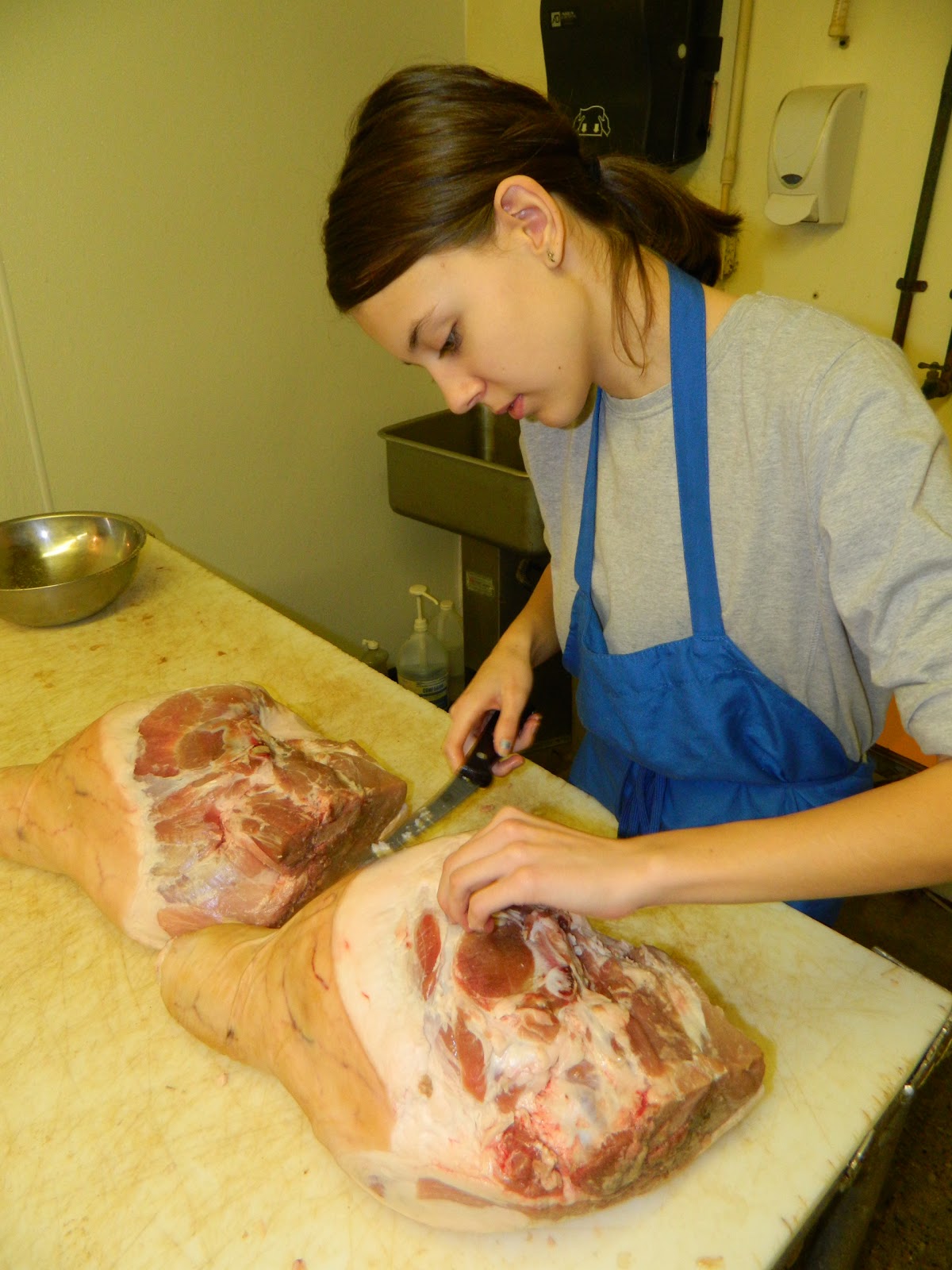
The 4-H county fair is here again and this year is no different from last year...we country cured a ham. It is amazing to think that our grandparents had no choice but to cure hams (that is if they didn't want them to spoil) but we now only do it by choice. We truly have come a long way but despite all that I believe that curing hams is still a valuable skill and a great reminder of how good we have it.
Kylee worked hard on her hams.

She trimmed them with loving care.


And smoothed down fat with a smile.

Adding the cure it is always her favorite part. She needed a little help from our friends over at 4 Quarters Perry Locker but once she saw Kristen do it she remembered how to stuff a hock.

And stuff she did.

She enjoys stuffing the hock a little too much but that's just my opinion.

After a good trim, a lot of cure, and some pretty wrapping paper the ham is ready for hanging...at least 5 months of hanging.

It is amazing how this bloody, fatty, hunk of meat turns into...

This blue ribbon deliciously smokey country cured ham.

It smells so good she can hardly contain herself...goofy girl!

Tonight is the big sale. Wish Miss Kylee luck. Hopefully her ham sells well.


Sunday, July 8, 2012

Pig Care Priority

Pork producers are always looking for ways to better their farming practices and pig care is on the top of their list.


Several producers gathered for a pig care meeting. This meeting was not only a refresher course but it also introduced the producers to some new ideas to improve their practices.


The meeting focused on the importance of individual pig care despite the large numbers being raised in hog barns. Some creative methods were suggested to help produces with this task.  


No pork producer meeting would be complete complete without a pulled pork meal. Yum!


The whole Windmann crew was there, too.


Farmers are constantly changing and improving their techniques and pork producers are no different. We strive to take better care of our animals because we care about the product that we produce and the animals that we raise.